Budget 2026 - Individuals & Families

Investment Solutions | Wealth Management Solutions | Significant Wealth Owner Solutions | Specialist Advice Solutions
By Anne-Marie Tassoni, Partner - Private Wealth Management James Cummings, Portfolio Adviser
Treasurer Jim Chalmers has handed down the most structurally ambitious Federal Budget in over two decades and for individuals and families, the changes reach well beyond the usual cost-of-living measures into the foundations of how Australians invest, hold assets, and plan for the future. The surprise – if at all the case – is the willingness to break promises made as recently as the last election to deliver it.
Posted 13 May 2026

Labor’s fifth budget is, by any measure, a bold one. Framed around ‘resilience and fairness’, the 2026–27 budget delivers a trio of landmark tax reforms; to capital gains, negative gearing, and family trusts, alongside relief for everyday workers through new offsets and deductions. But for individuals and families reading closely, the budget is as notable for what it reverses as for what it introduces. Policies explicitly ruled out before the last election have been quietly revived. Tax cuts long promised and in some cases years in the making have been repackaged as fresh generosity. The overall picture is ambitious, consequential, and not without its contradictions. 
  • The 50% Capital Gains Tax (‘CGT’) discount will be abolished from 1 July 2027. Gains accrued before that date remain protected, but all assets including the prized pre-1985 holdings fall under the new rules from that point onward. Superannuation funds are unaffected.

  • In place of the 50% discount, gains from 1 July 2027 will be taxed on an inflation indexation basis subject always to a minimum rate of 30%.

  • Negative gearing on residential property is restricted to new builds from 1 July 2027. All properties held before Budget night are fully grandfathered, though purchases of established property made after the announcement lose the ability to offset losses against other, non-property income.

  • Discretionary family trusts will face a 30% minimum tax from July 2028, a policy Labor took to the 2019 election, lost on, and then explicitly abandoned in 2022.

  • A new $250 Working Australians Tax Offset (‘WATO’) and $1,000 instant work-related expenses deduction will be welcomed by those earning personal exertion income; but to put into context, that ‘tax break’ probably won’t pay for your coffee once a week.

  • A $150 energy rebate and extended fuel excise cut offer near-term relief, though older Australians should note the reduction in the private health insurance rebate for those aged 65 and over.

The centrepiece of this budget is a package of three interconnected tax reforms; capital gains, negative gearing and family trusts which together represent the most significant structural change to the Australian tax system since the GST. All three were either taken to an election and lost or explicitly ruled out by this government in 2022. They are back, but reframed around intergenerational fairness. 

Capital Gains Tax 

From 1 July 2027, the 50% CGT discount will be replaced with cost base indexation and a 30% minimum tax rate on real gains, applying to all assets including pre-1985 holdings. The grandfathering is time-based, not asset-based, to protect gains before that date only. Current asset holders will likely need a valuation of all CGT assets on 1 July 2027 to evidence their starting value under the new regime or rely on the ATO’s calculator. Superannuation funds are unaffected by this change and retain the current 1/3rd discount. 

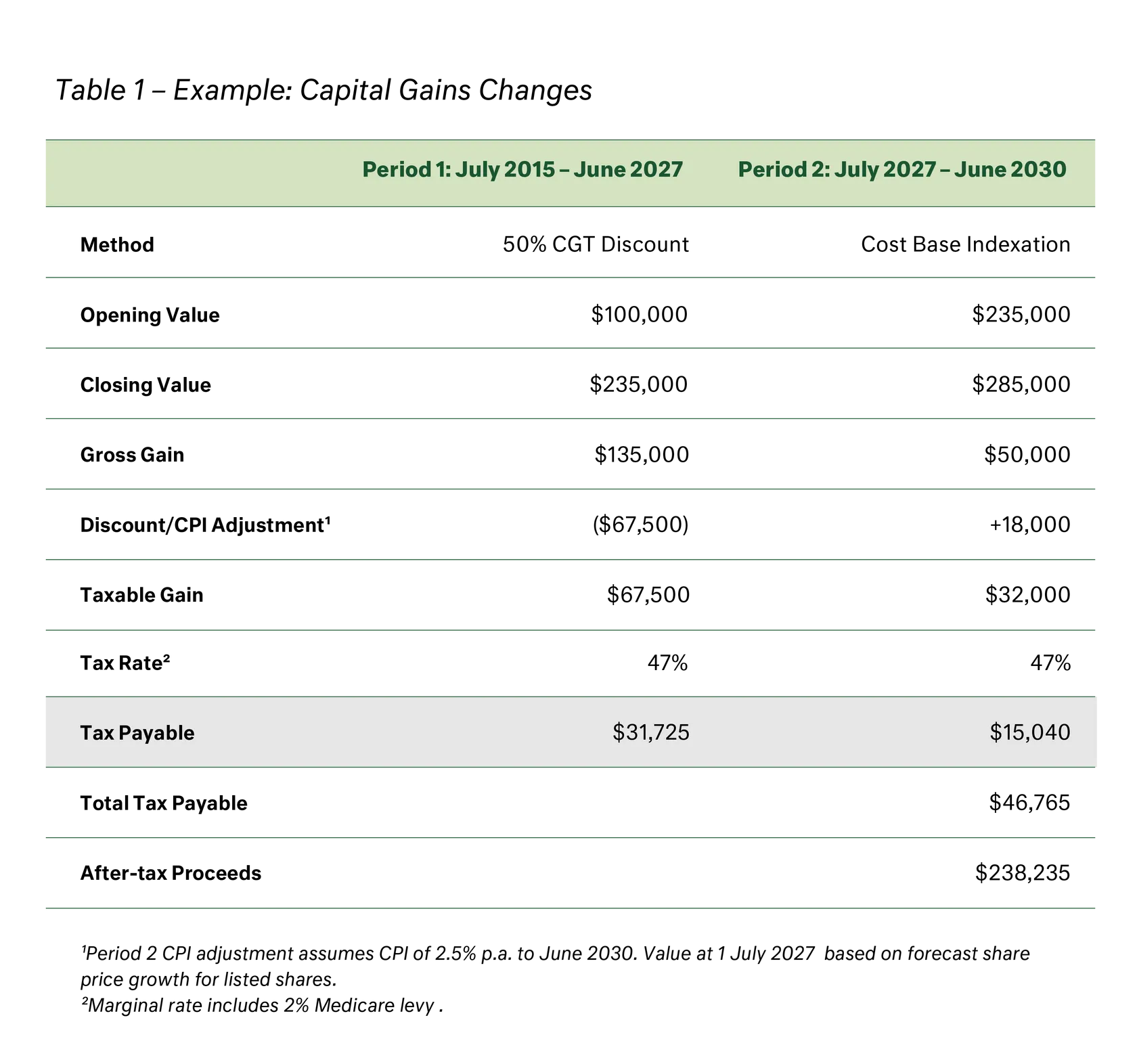
To illustrate how the transitional rules work in practice, consider an investment in Commonwealth Bank shares (‘CBA’) held across the reform date. An investor purchases $100,000 of CBA shares in July 2015 at $85 per share. These are later sold in June 2030 - total proceeds of $285,000 over a 15-year hold, with an assumed share price near $240. Under the proposed rules, the gain is calculated in two parts: the gain accrued to 30 June 2027 retains the 50% discount, while the gain from 1 July 2027 to sale is subject to cost base indexation. For a high-income earner at 47%, the outcome is: 

Table - Budget 2026 - Individuals & Families

The grandfathering provides meaningful protection on the pre-2027 gain, however, it does not eliminate the impact of the new rules entirely. The post-2027 gain of $50,000 is subject to indexation, and at a 47% marginal rate the investor pays $15,040 on that period - compared to $11,750 if the 50% discount continued to apply. That difference of $3,290 represents the additional tax attributable to the abolishment of the 50% discount method. The impact may seem modest in this example, but so is the assumed inflation and share price growth – should either or both of those factors experience periods of higher-than-average rates, the additional tax liability under indexation grows accordingly. 

The CGT changes announced are complex and – much like Div 296 – will probably look very different after public consultation.

Negative Gearing 

Negative gearing on residential property will be limited to new builds from 1 July 2027. All properties held before Budget night are fully grandfathered. The policy was ruled out before the last election; it has returned with more generous grandfathering, but the same structural intent. For those buying established residential property, losses can still be offset against residential property income and carried forward to future years, but they can no longer be deducted against other income such as wages. The tax advantage of holding a negatively geared established property, for new investors, is materially diminished. 

Family Trusts 

A 30% minimum tax will apply from 1 July 2028 to all discretionary trust distributions, and in a practical change to the taxpayer system, it is the trustee who will pay this minimum tax with an individual beneficiary then able to claim a non-refundable credit for the tax paid at the trust level. Bear in mind that this is policy by announcement and at this stage, it appears corporate beneficiaries will be unable to claim the credit for the trust tax paid. Streaming income to lower-earning family members and corporate beneficiaries – a cornerstone of trust planning for decades – will have significantly limited effect going forward. Fixed trusts, special disability trusts, charitable trusts and deceased estates are exempt, as are some categories of income including those derived from primary production and from assets of discretionary testamentary trusts existing at announcement.   

For pre-retirees with a discretionary trust at the centre of their wealth, business or succession planning, this is the reform that warrants the most immediate attention. A three-year CGT-free rollover window opening from 1 July 2027 provides time to restructure without triggering a tax event – that window rewards those who plan early. We explore an example of how this may affect family trusts here.

Beyond the structural reforms, the budget delivers relief for working Australians, albeit relatively modest.  

A $250 Working Australians Tax Offset (‘WATO’) will be automatically applied to tax returns from July 2027, lifting the effective tax-free threshold by nearly $1,800. From this financial year, a $1,000 instant deduction for work-related expenses delivers an average benefit of around $205.  

These are genuine benefits but presented alongside some of the most significant tax increases on capital and investment in a generation, they function as much as political framing as fiscal generosity. 

On the cost-of-living front, a $150 energy rebate for households and small businesses continues and the fuel excise cut of 26.3 cents per litre, in place since late March, extends for three months. Hardly expected to move the needle in the face of prospective inflationary pressures beyond the next three months. 

For older Australians, the government has confirmed a pre-budget announcement that the higher private health insurance rebate currently available to those aged 65 and over will cease. The change is framed as tax reform, but the practical effect is an increase in premiums of up to $255 (industry-wide annual premium increases aside) for a cohort that tends to rely more heavily on their cover.  

1. What are the key tax reforms introduced in this budget?

The budget introduces major changes to capital gains tax, negative gearing and family trusts. Together, these represent a significant structural shift in the tax system, with a focus on intergenerational fairness and increased taxation on capital.

2. How will the capital gains tax changes affect investors?

From July 2027, the 50% CGT discount will be replaced by cost base indexation and a minimum 30% tax on real gains. While gains accrued before this date are partially protected, future gains are likely to face higher effective tax rates.

3. What changes are being made to negative gearing?

Negative gearing will be restricted to new residential builds from July 2027. Established properties remain grandfathered, but new investors will no longer be able to offset losses against other income, reducing the tax benefits of these investments.

4. How will the family trust reforms impact financial planning?

A 30% minimum tax on discretionary trust distributions from July 2028 will significantly limit income streaming strategies. This reduces flexibility for families using trusts for wealth and business purposes and arrangement re-structures are likely required.

5. What are the changes for wage earners?

The budget includes relief through a $250 tax offset, a $1,000 work-related expenses deduction and temporary energy and fuel support.

As partners in your investment journey, we monitor, examine, and navigate change. The Federal Budget is one such factor in our highly considered investment strategy and wealth management process.

This article is one part of our 2026 Budget series. To read more of our Budget commentary, click the links below:

For more information on our approach to wealth strategy and investment management, please contact us on +613 9655 5000 or contact our experts here.

Speak to one of our advisers to learn more: am.tassoni@cameronharrison.com.au

Sourced from:

The Commonwealth of Australia – Budget Papers