The budget is framed as a triumph of fairness, but that narrative doesn’t hold once the numbers are unpacked. The modest tax relief offered to workers and younger Australians is outweighed by the steady drag of bracket creep, leaving wage earners paying more over time despite the headline offset.
Bracket creep, rather than reform or productivity gains, does the heavy lifting in repairing the budget. Income tax receipts rise quietly but materially, locking in the highest income‑tax take as a share of GDP in decades and placing the burden squarely on those whose income is primarily derived from wages.
The property changes represent the most significant overhaul of housing taxation in 30 years, but the impact is likely to be more controlled than initially feared. Grandfathering, exemptions and delayed commencement soften the effect, pointing to a measured correction in prices rather than a dramatic reset.
Almost every cohort contributes something under this budget. Retirees, investors, small businesses, farmers, EV buyers and smokers all face higher costs or reduced concessions. While the equity case against the CGT discount is defensible, the cumulative effect is a broad‑based tax lift rather than a narrowly targeted redistribution.
More troubling than any single measure is the opportunity missed. The budget focuses on revenue and redistribution, not productivity, housing supply or long‑term growth. Capital risks being nudged away from innovation and expansion towards defensive assets, leaving the budget remembered less for reform and more for a quiet but enduring tax shift.
Budget 2026 Summary - The budget that asks a lot
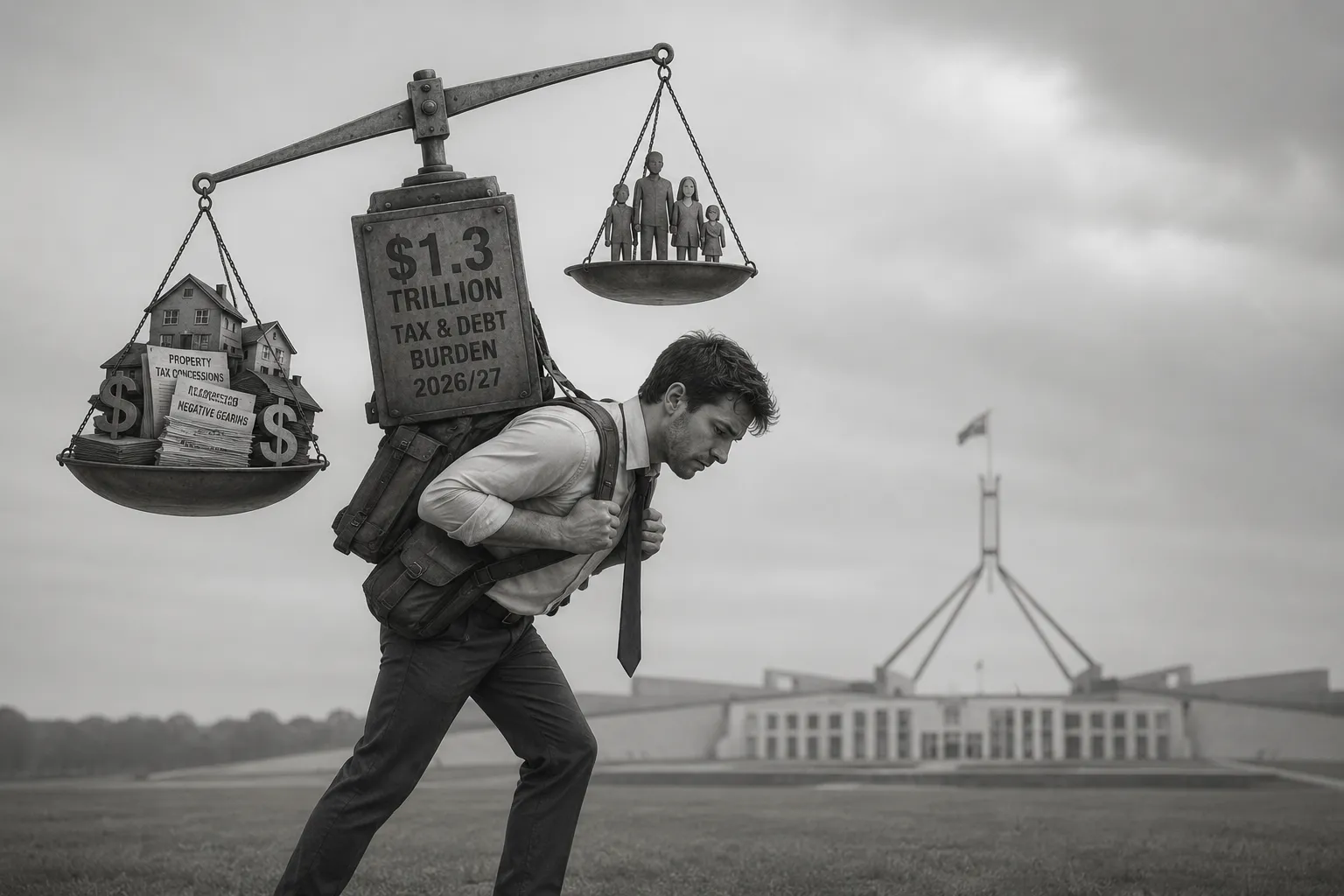
The Treasurer’s headline beneficiaries do not quite survive their own arithmetic.
Workers receive a ‘Working Australians Tax Offset’ of up to $250 a year from 2027-28 – less than the cost of a weekly cup of coffee – while bracket creep silently pushes the tax-to-GDP ratio from 23.6 per cent above 25 per cent over the decade. A $5-a-week offset is a rounding error against an inflation-driven escalator that lifts every wage earner into a higher bracket, year after year.
Young Australians may inherit a property market reshaped by the shift to capital gains indexation, a minimum tax of 30 per cent on indexed gains, and the restriction of negative gearing to new builds for any established property bought from Budget night. But they also inherit gross debt forecast to hit $1.3 trillion – 35.6 per cent of GDP – by 2029-30. More than $9 in every $10 of the budget’s bottom-line improvement came from a windfall the Commonwealth did nothing to earn, courtesy of bracket creep.
Confirmation comes from an unexpected quarter. The Parliamentary Budget Office itself notes that younger Australians, who derive most of their income from wages rather than assets, will bear the full force of bracket creep. The cohort this budget claims to champion is the cohort Treasury is counting on for $15bn in upgraded income tax receipts over five years.
The list of losers is long, but not uniform. More than three million retirees with private health cover will pay $226 to $255 more a year as their rebate is trimmed. Self-funded retirees face a 30 per cent minimum tax on real capital gains, framed by Treasury as aligning the rate on lifetime gains with the marginal rate of an average worker. Family enterprises, farms and small businesses face a 30 per cent minimum tax on discretionary trusts, raising $4.4bn a year by 2029-30 – a structural lift no future government will easily repeal. Property investors find negative gearing closed off on any established home bought after Tuesday night. Electric vehicle buyers, only recently courted, see the fringe benefits tax exemption withdrawn. Smokers, driven further into the black market, deliver $1.2bn less in excise than Treasury counted on six months ago.
The distributional case for the headline changes is, in fairness, not nothing. Treasury notes that one-third of all capital gains are realised by individuals in the top 1 per cent of lifetime income earners, and more than half by the top 10 per cent. The 50 per cent discount has, in periods of low inflation and strong house price growth, over-compensated investors handsomely; indexation does not. That is the policy theory. The political theory – that this would be sold as a reform of equity rather than a revenue measure – is harder to sustain.
There are also losers the Government will not name. Even on the more sober industry modelling, the cumulative pressure on residential property risks driving some marginal landlords out and tightening rental supply. A housing-affordability budget that inadvertently lifts rents would be a sleight of hand – though, as set out below, that is not the most likely outcome.
On Treasury’s own numbers, this is the highest income-taxing administration on record – personal income tax climbing to 12.8 per cent of GDP by 2029-30, the highest since 1989.
The Treasurer has bet his reformer’s legacy on the most ambitious overhaul of property tax in three decades. Whether it amounts to a detonation, or a controlled demolition depends less on rhetoric than on detail – and the detail is softer than the pre-Budget speculation.
The 50 per cent CGT discount is replaced by inflation indexation for established properties purchased from Budget night, effective 1 July 2027, with a minimum tax rate of 30 per cent on indexed gains. New builds are carved out entirely and may elect either indexation or the 50 per cent discount. Existing investors can lock in their pre-July 2027 cost base via a valuation or an ATO calculator – meaning, a likely rush to valuers, not to real estate agents. Negative gearing on established properties is restricted from Budget night for new purchases; existing arrangements are grandfathered, with excess losses carried forward against rental income or future capital gains. Build-to-rent and private investors supporting government housing programs are exempt.
The price impact, on most credible estimates, looks measured rather than catastrophic. Industry modelling has clustered around house price declines of one to five percentage points relative to baseline, and the changes announced sit at the softer end of that range. Analysis points to a FY27 forecast of a 3.5 per cent fall, followed by 3.5 per cent growth in FY28 – a modest cycle correction, not a reset to post-World War 2 housing economics. Nor is every investor worse off: Treasury’s own analysis suggests that, over the past two decades, the ASX 200 would have been treated more favourably under indexation than under the 50 per cent discount, and Melbourne housing investors who bought at the peak in 2021 would, by 2026, be carrying a tax loss under indexation rather than paying CGT on a nominal gain.
Three structural factors do most of the heavy lifting under prices. Supply is acutely constrained, with total listings outside Sydney and Melbourne running 40 to 60 per cent below their ten-year averages. New listings have, without exception, fallen when prices have fallen – an automatic stabiliser there is little reason to doubt this time. And a deep pool of First Home Buyers has historically stepped forward on even modest price softness, effectively reshuffling demand from the most marginal investor to the least marginal owner-occupier. Only five per cent of new investor financing currently flows to newly constructed dwellings; lifting that share is, the Government would argue, precisely the point.
That said, the timing remains questionable. To recast housing incentives in the very week the Reserve Bank is openly weighing further cash rate rises is, at best, an act of conviction; at worst, it loads the central bank with the full weight of the inflation fight while Treasury runs a parallel demand-management experiment. Sentiment shocks travel faster than fundamentals, and auction clearance rates have already softened. The legislation also requires cross-bench support to pass the Senate, and a one-year grace period before the changes take effect leaves real room for amendment. The final policy may yet look different from the one announced on Budget night.
The missed opportunity grates more than any misstep. This was a moment for broad-based reform – productivity-driven growth, supply-side action on housing, a serious attempt at the causes of rising prices rather than the symptoms. The CGT changes will, at the margin, discourage capital from innovative, expansionary companies and toward the defensive shelter of high-yielding, franked dividend stocks like the banks and the supermarkets. The Government has signalled openness to consultation on the treatment of early-stage and start-up businesses, which is welcome; whether that openness extends further will determine whether this budget is remembered as a careful rebalancing or a clumsy one.
The three measures at the heart of this budget – the minimum tax on indexed gains, the restriction of negative gearing on established homes, the minimum trust tax – were not put to voters at the 2025 election. They have been widely characterised as broken promises. Asking Australians to trust the next round of “tax cuts down the track” after a budget built on undisclosed rises is asking a great deal.
Australians have learnt to read “more room down the track” in reverse: more tax now, relief later, contingent on yet another mandate. It is the oldest trick.
The detail of Budget 2026 does not match its spin. The retiree, the investor, the mortgage holder, the renter, the smoker, the EV buyer, the farmer – each pays a little, or in some cases a lot. The young Australian, handed a $5 note and a $1.3 trillion debt, pays most quietly of all. A budget for everyone, the Treasurer called it. This is half right – everyone loses a bit or a lot.
As partners in your investment journey, we monitor, examine, and navigate change. The Federal Budget is one such factor in our highly considered investment strategy and wealth management process.
This article is one part of our 2026 Budget series. To read more of our Budget commentary, click the links below:
For more information on our approach to wealth strategy and investment management, please contact us on +613 9655 5000 or contact our experts here.
Sourced from: