The Lie of Average Returns – Why Sequencing Risk is the Silent Threat to Family Wealth

Investment Solutions | Significant Wealth Owner Solutions
By Paul Ashworth, Managing Partner, Chief Investment Officer
Why the order of returns, not the average, decides whether your family’s wealth survives the next thirty years – and why “how much risk” matters more than “which assets”.
Posted 03 June 2026
  1. Average returns are not what determine outcomes – sequencing is.
    Two families with identical wealth, spending, and long-run average returns can experience entirely different outcomes depending on when returns occur. Once withdrawals begin, early negative returns can permanently impair capital, as assets sold to fund spending cannot participate in future recovery.

  2. The critical question is how much risk, not what to own.
    Investment outcomes are driven more by the sizing of risk relative to a family’s spending, obligations and tolerance for loss than by asset selection. Poor risk sizing, particularly in the presence of withdrawals, is the mechanism through which sequencing risk turns volatility into permanent loss of capital.

  3. Significant wealth amplifies, rather than reduces, sequencing risk.
    Larger and more structured outflows, longer time horizons, illiquid assets, concentration, and governance pressures increase exposure to poor return sequences. For Australian families in particular, tax settings and drawdown rules further intensify the impact, making sequencing risk a central, and often under-managed, threat to long-term wealth.

Sequencing risk is the danger that the order in which returns arrive, not their long-run average, decides whether a portfolio survives. Once a family is drawing income, an early run of poor returns does lasting damage, the capital sold to fund spending is no longer there to share in the recovery. Two families with the same average return and the same spending can end up with vastly different wealth, decided only by when the good and bad years fell.

Picture two clients, both 62, each having sold a business for $15 million after CGT and holding around $12 million more, mostly in super. Both retire on the combined $27 million, draw about $650,000 a year, and land in a balanced 60/40 portfolio. One retires in January 2007, the other in January 2010; over the next thirty years both earn the same long–run average return. One runs out of money in their early eighties; the other dies leaving more than $40 million to the next generation. Same wealth, same spending, same average but wildly different lives. The difference is sequencing risk, the most under-managed risk in significant Australian families’ wealth strategies.

The industry talks in averages – “Australian equities have returned about 9.5% a year.” True, and almost useless to a family drawing income. Once you draw from a portfolio the average stops determining the outcome and the order of returns takes over: a poor market in the first few years of drawdown does damage no later rebound can undo, because the assets sold to fund spending are no longer there to recover. Take one set of annual returns and three scenarios, with strong returns first, poor returns first and returns shuffled. When there are no withdrawals from the portfolio, each return scenario ends at the same portfolio value. However, once income is being drawn, the same scenarios produce anything from exhaustion to more than $40 million.

Chart - Identical returns family wealth

Most investment conversations begin with the wrong question – what to buy. The more important one is how much risk a family should take at all. This is the heart of Victor Haghani and James White’s The Missing Billionaires (2023): given how rewarding equities have been for a century, why are there so few billionaire dynasties? Their answer is that the missing billionaires were undone not by picking the wrong assets but by sizing their risk incorrectly relative to their spending, and sequencing risk turns bad sizing into permanent loss. The formal version is the Merton Share: the right exposure to risky assets rises with their expected excess return and falls with both their volatility and the family’s aversion to loss. The practical lesson is that doubling exposure does not double welfare, concentrated or leveraged positions must clear a higher bar, and a family should decide first how much risk it can hold through a severe drawdown without forced sales – everything else follows.

It is tempting to think this affects only the average retiree drawing 4% from a million–dollar balance, not families with $10–100 million. The opposite is true – significant wealth is more exposed, for five reasons:

•    Larger structured outflows: Lifestyle costs of $600,000-$1.5 million plus philanthropy, family–office costs and gifting add up, even when the percentage looks modest.

•    Longer horizons: Plans run across two or three generations, so a poor early sequence can permanently impair the compounding base.

•    Larger illiquid weightings: Property, private markets, founder equity and operating businesses cannot be sold gracefully into a falling market, and capital calls often arrive when markets are down.

•    Concentration in the business asset: A single sale crystallises concentration into market risk at one moment, with its own sequence.

•    Costs of forced sales: Selling a private holding into a depressed market triggers tax, reputational and co-investor consequences beyond the headline loss.

Wealthy families also spend longer in the “funding danger zone”, the transition from accumulation to drawdown, when balances are largest and the horizon still long. For those retiring in their late forties or fifties, that window can be two decades wide.

Sequencing risk cannot be eliminated, but it can be measured, managed and substantially mitigated through a deliberate framework. Ours rests on six disciplines, each well-established and tested across cycles.

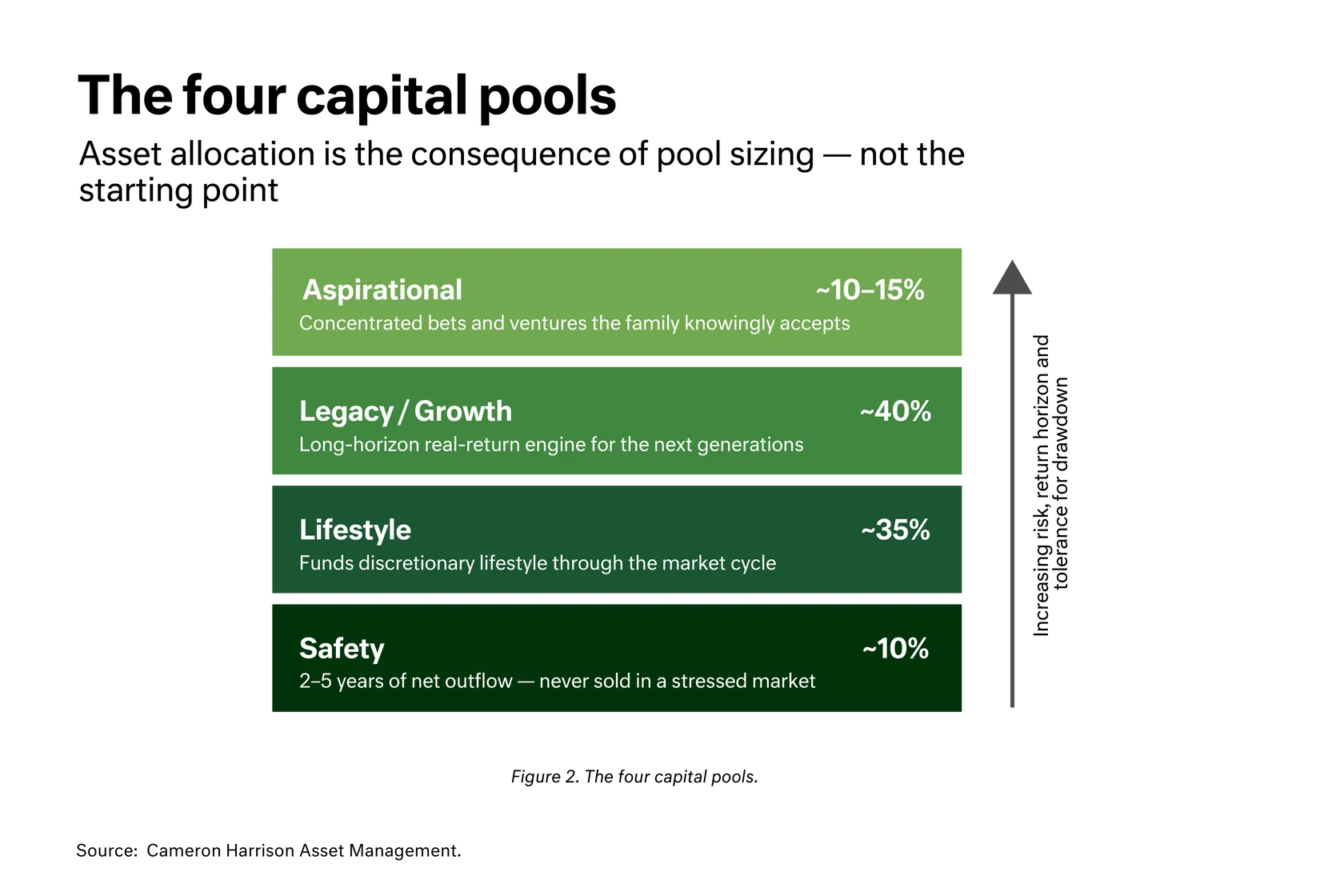
1.       Capital pools, not just an allocation: We start with the family balance sheet and ten-year cash flow profile, not an asset allocation, dividing capital into four pools (below). The Safety pool – two to five years of net outflow – is the structural defence: drawn down in falling markets so growth assets are never sold cheap, then rebuilt from the growth pools as markets recover.

Chart - the four pools- asset allocation

2.       A genuine liquidity ladder: Behind the Safety pool, liquidity lengthens from cash and term deposits through high–grade fixed income and credit to public equities, with private and direct holdings last – so spending never forces an unwanted sale.

3.       Dynamic spending rules: Bengen’s 1994 “4% rule” is no longer considered safe or optimal. We prefer a floor-and-upside rule: a protected real floor funded from sequence independent sources, with spending above it flexing to performance within limits (typically no more than 10% a year).

Chart- the floor holds

4.       Asset-liability matching: Known, fixed commitments – a tax bill, school fees, a philanthropic pledge, baseline lifestyle – are matched to dedicated assets (inflation-linked bonds, lifetime income streams, laddered deposits), so a growth asset is never sold under stress to meet them.

5.       Tax-aware sequencing: With CGT, franking, the 15% super earnings tax and Division 296 all interacting, tax and sequencing are one problem; rebalancing thresholds widen for low cost base positions.

6.       Behavioural governance: The hard part is holding the line when markets fall 25%. An Investment Policy Statement, an investment committee, and a relationship lead who has seen several cycles separate a framework that works from one that exists only on paper.

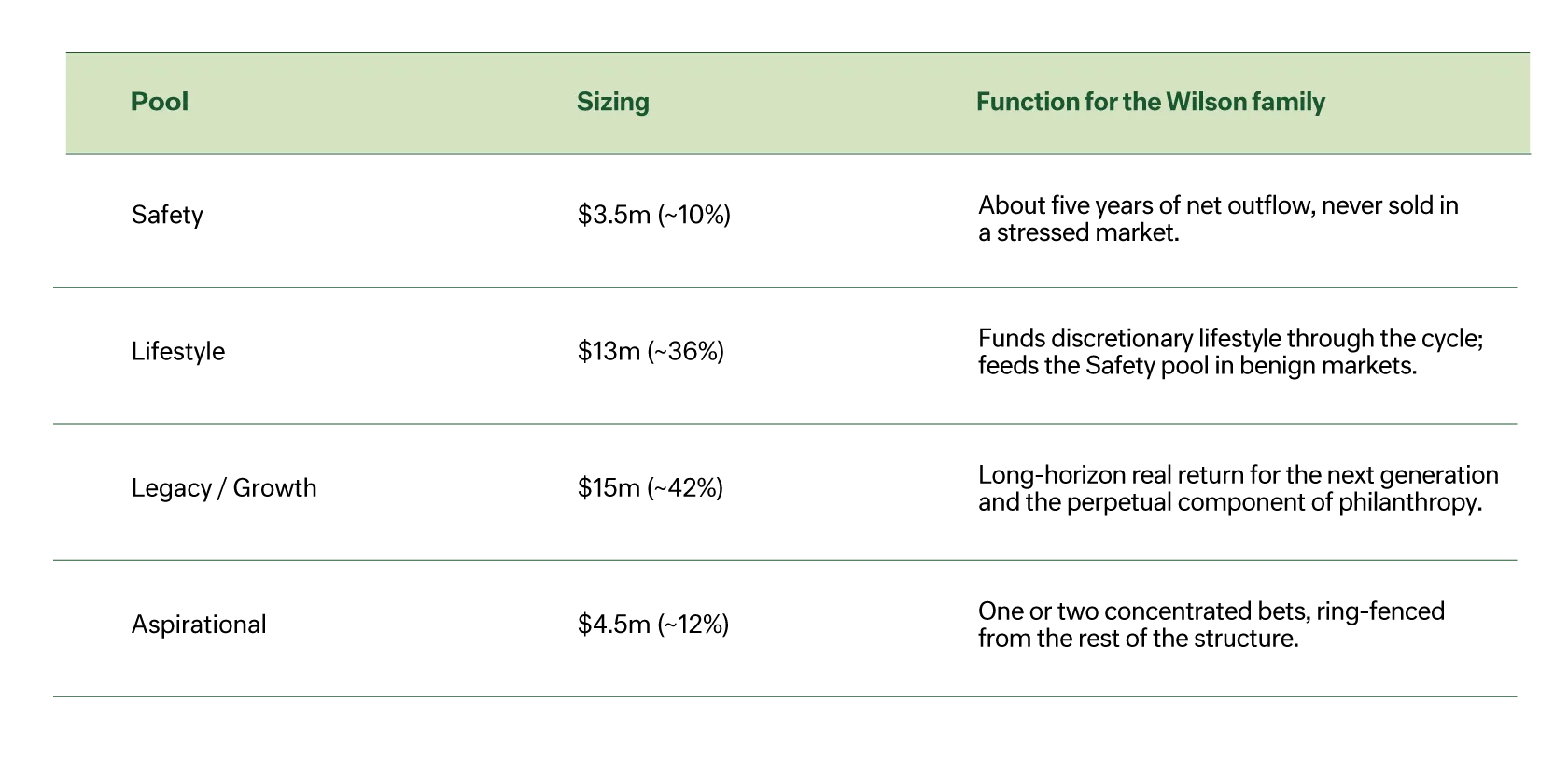
Consider the Wilson family: $28 million from a business sale, $8 million more in super, a two-generation horizon, and projected outflows averaging $700,000 a year against $36 million invested – a modest 1.9% draw, but enough in dollar terms to demand explicit management. The framework sizes their wealth roughly as follows (illustrative), with a protected floor of $350,000 and stress–testing across six scenarios before the plan is executed.

Table  - Example for the article
What is sequencing risk?

It is the risk that the order of returns, not their long-run average, determines a portfolio’s outcome once a family is drawing income. A poor run early in drawdown causes damage later recoveries cannot fully undo, because the assets sold to fund spending no longer share in the rebound.

How can a family manage sequencing risk?

It cannot be eliminated, but it can be substantially mitigated through a governed framework: capital pools, a liquidity ladder, a dynamic floor-and-upside spending rule, asset-liability matching, tax-aware sequencing, and behavioural governance through an Investment Policy Statement.

How does Australia’s super and tax system affect sequencing risk?

Features such as the transfer balance cap ($2.0 million per person in 2025–26), Division 296 from 1 July 2026, minimum pension drawdowns, franking credits and the CGT discount all interact with the order-of-returns problem, making asset allocation and the timing of realisations consequential.

Across more than four decades advising significant Australian families, one pattern stands out: the most reliable predictor of which families’ wealth survives two or three generations is not their stock picking or their structures, but whether they named and managed the sequencing risk and held to a framework through both good times and bad. Sequencing risk does its damage quietly, through the slow interaction of poor return sequences and inflexible spending. Managing it well is less about predicting markets than about deciding, in advance and in writing, how much risk a family will carry and how its spending will respond when markets fall. The toolkit is mature and well documented; the challenge is discipline and governance, not innovation.

Paul Ashworth, Managing Partner, Chief Investment Officer

David Clark, Partner – Investment Research

Richard Price, Senior Consultant – Advisory Board

Anne–Marie Tassoni, Partner – Private Wealth Management

Tristan Bowman, Partner

Speak to one of our advisers to learn more: paul.ashworth@cameronharrison.com.au

Sourced from:

Photo by iStock