Fixed Income: Why, How, and When

Investment Solutions
By Tristan Bowman, Partner William Fisher, Portfolio Adviser
Posted 04 June 2026
  • Fixed income is regaining relevance in a more complex macro environment 
    Higher yields, persistent inflation risks and an uncertain rates path have reshaped the opportunity set for fixed income, making it relatively attractive compared to equities and property. 

  • Purpose-led portfolio construction is critical 
    The role fixed income plays – diversification, income, capital stability or liquidity – should determine the level of risk taken and the structure of the strategy, rather than a one-size-fits-all allocation. 

  • Active management matters more than ever 
    With diversification less reliable and market conditions shifting, fixed income portfolios must be actively managed across duration, credit, issuer and security type to adapt to changing economic and market dynamics. 

The macro backdrop for the fixed income asset class provides both challenges and opportunities for investors. There are four key themes that are currently guiding our fixed income strategy, as tabled below:

Table  - Macro Context and Challenges

Two implications follow: 

  1. Higher yields make fixed income relatively attractive compared to equities and property 

  1. Fixed income strategies need to be actively managed to the economic environment  

The questions for investors to answer are twofold: what is the role of fixed income? And how does the asset class help navigate the macro challenges? 

The first principle in fixed income management is understanding its purpose and what you are trying to achieve: asset diversification, income stability, income maximisation, capital stability, store of liquidity, defensive positioning, or a mix of these. This will guide considerations on the level of risk you are willing to take on, and what types of risks you are trying to protect against.  

For our Core Interest Income strategy, we seek to: 

  1. Diversify portfolios away from equity risk, 

  2. Produce a reliable source of income, liquidity and capital stability to a diversified portfolio, and 

  3. Achieve an income return of +2.0% over 3-year government bonds. 

We likewise have lower and higher risk fixed income strategy; our Treasury strategy is a lower-risk strategy for shorter-term investors, whilst our Enhanced Interest Income strategy is a higher-yielding, higher risk strategy for wholesale investors.  

The purpose of each strategy will be different, and needs to match the investor’s risk appetite, investment objectives and complement other asset holdings.  

With purpose and objectives defined, portfolio construction is then guided by multiple considerations.  

  • Fixed versus floating – this is the primary call and will be guided by long-term interest rate outlooks.  

  • Credit quality – the type of credit risk to take on: investment grade, or high yield.  

  • Issuer type – corporates, financials, governments (and semi-governments), offshore issuers.  

  • Security type – Senior unsecured, subordinated, hybrid, covered bonds, RMBS and ABS, secured versus unsecured, term deposits. Each sits at a different point in the credit stack with a different risk–return profile and a different cycle behaviour. 

  • Relative value – for a given level of risk, what securities offer the best risk-reward proposition? 

These positions are not and should not be static. They must be managed over time according to the economic and market environment.

Chart- how the security-type composition of our Core Interest Income strategy has evolved

The above chart illustrates how the security-type composition of our Core Interest Income strategy has evolved over the past decade. It is a deliberate, actively managed portfolio, not a static strategy.  

Table - Fixed Income 2016/2019/2022

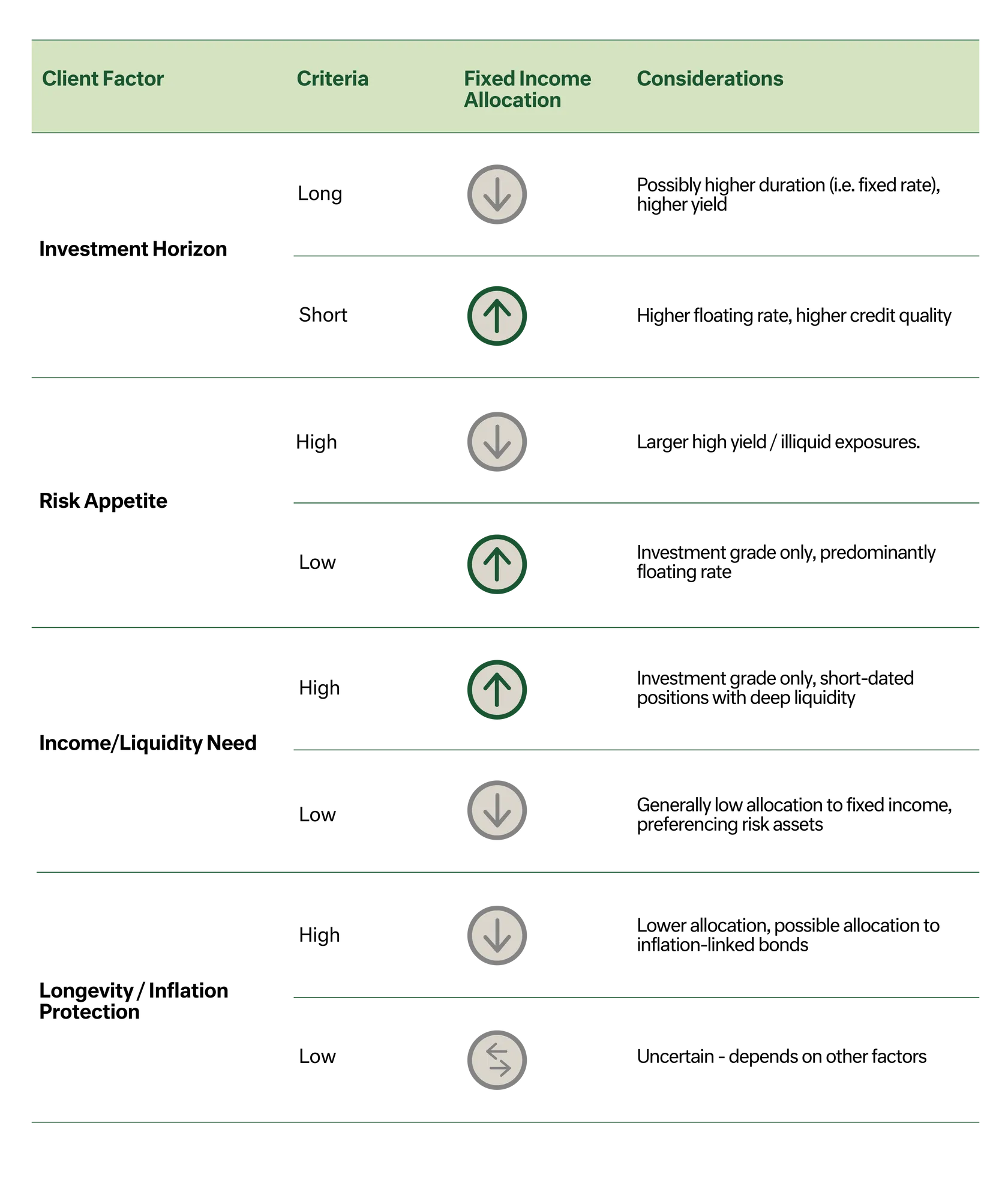
Fixed income can be a ballast to equity, property and alternative holdings in a portfolio. It can also be a source of liquidity and income in periods of market stress. But should you have a fixed income allocation, and if so, how much? 

Table -  Fixed Income in a Multi-Asset Class Portfolio

Fixed income is not a one-sized fits all approach. Client considerations underpin bespoke portfolio management, both from an overall fixed income allocation and an underlying fixed income strategy positioning.  

1. Why has fixed income become more attractive in the current environment?

Higher starting yields have improved the income and return potential of fixed income, while ongoing macro uncertainty has increased the value of diversification, liquidity and capital stability within multi-asset portfolios. 

2. How do different fixed income strategies suit different investors?

Each strategy serves a different purpose. Lower-risk strategies may suit investors with shorter time horizons or higher liquidity needs, while higher-yielding strategies may appeal to investors with a higher risk appetite. The right approach depends on individual objectives, risk tolerance and existing asset allocations. 

3. Why is active management important in fixed income today?

Rate market volatility, shifting relative value and changing credit dynamics mean static portfolios may fail to capture opportunities or manage risks effectively. Active management allows portfolios to evolve in response to the economic cycle and changing market conditions. 

Speak to one of our advisers to learn more: tristan.bowman@cameronharrison.com.au