
Queensland Budget 2026: Banking on 2030

By David Clark, Deputy Chief Investment Officer
Posted 02 July 2026

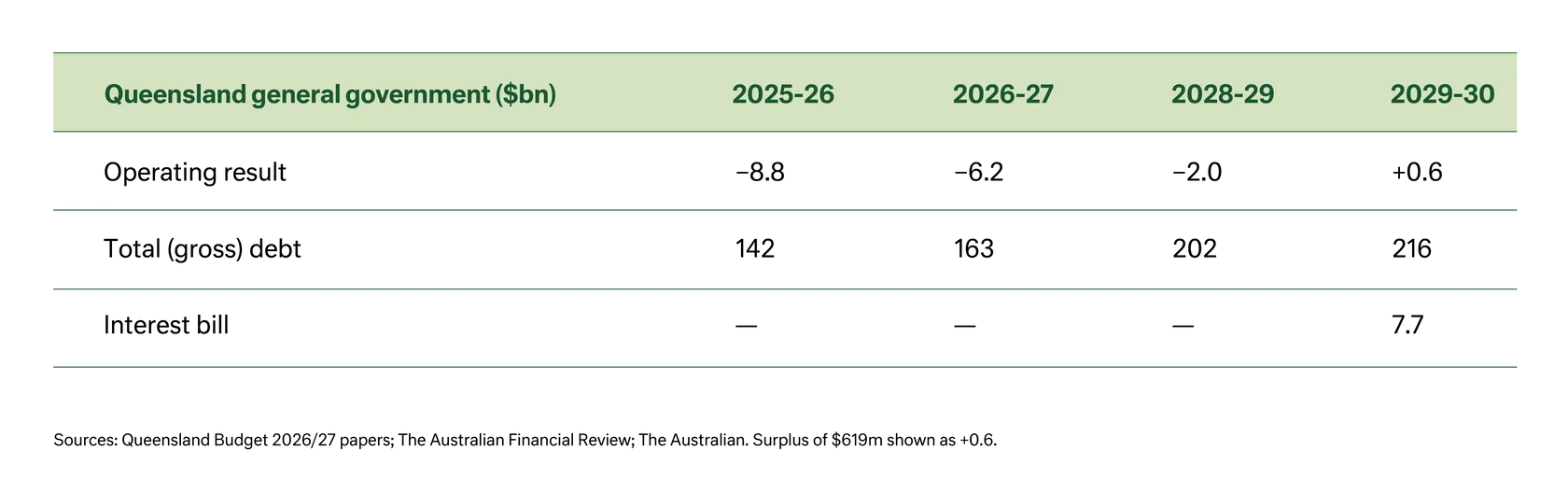
The Queensland Budget 2026/27, handed down on Tuesday by Treasurer David Janetzki, promises a slim $619 million surplus by 2029-30, at the very end of the forwards. Getting there means absorbing a worsening $8.8 billion operating deficit this year and a $6.2 billion deficit in 2026-27, while total debt climbs from about $142 billion to roughly $216 billion by 2030 and the interest bill reaches $7.7 billion a year. The surplus rests on ambitious assumptions, revenue growth of 5.1 per cent and expense growth held to 2.6 per cent, and S&P has reiterated a negative outlook on the AA+ rating. Queensland is the most commodity and Olympics exposed of the eastern states: lowest net debt today, but the steepest trajectory and least margin for error.

Queensland handed down its budget on the same day as New South Wales, closing the 2026-27 state budget season. We have analysed the NSW budget and, before it, the Victorian budget; Queensland completes the picture, and it is the most contradictory of the three. It carries the lowest net debt of the eastern states today, yet runs their largest operating deficit, the steepest debt trajectory, and a fiscal balance S&P this week called “very weak.”

The tension is between a government that promised no new taxes, no service cuts and no forced redundancies, and a balance sheet that must fund a $10.6 billion Olympic build while bringing spending growth to a level Queensland has not achieved in years. Janetzki frames it as “long-term certainty” over “sugar-hit handouts”; in our reading it is an honest statement of intent wrapped around some heroic forecasts.
This was a deliberately austere budget for households. The government will spend $9.3 billion on cost-of-living relief in 2026-27, but almost none of it is new, largely continuing 50-cent public transport fares, frozen wholesale water prices and free kindergarten health checks. The one fresh measure is a $50 lift to the Back to School Boost, to $150 per primary-school student. Unlike NSW and Victoria, Queensland offered no vehicle-registration or toll relief, and there are no new taxes.

The defining commitment is the 2032 Olympics: $765 million in 2026-27 to begin venues and athlete villages, part of about $3.5 billion over the forwards, within a $10.6 billion Olympics budget split with the Commonwealth across 17 venues. The government declined to publish per-venue costs, citing an “arm wrestle” with contractors; with the Games six years away and construction costs rising, the absence of detail is itself a risk. Elsewhere, $520 million goes to ageing coal and hydro assets, and Stadiums Queensland receives $88.3 million plus $300 million for Suncorp Stadium.

Because the deficits come first – three of them. The 2025-26 operating deficit has worsened to $8.8 billion, a quarter of a billion worse than the Treasurer’s own first-budget forecast. It narrows to $6.2 billion in 2026-27 and about $2 billion in 2028-29, nearly double what last year’s budget projected, before the $619 million surplus appears in 2029-30. The surplus is real on paper, but it sits at the very edge of the forwards and depends on everything in between going to plan.

Table - QLD General Government

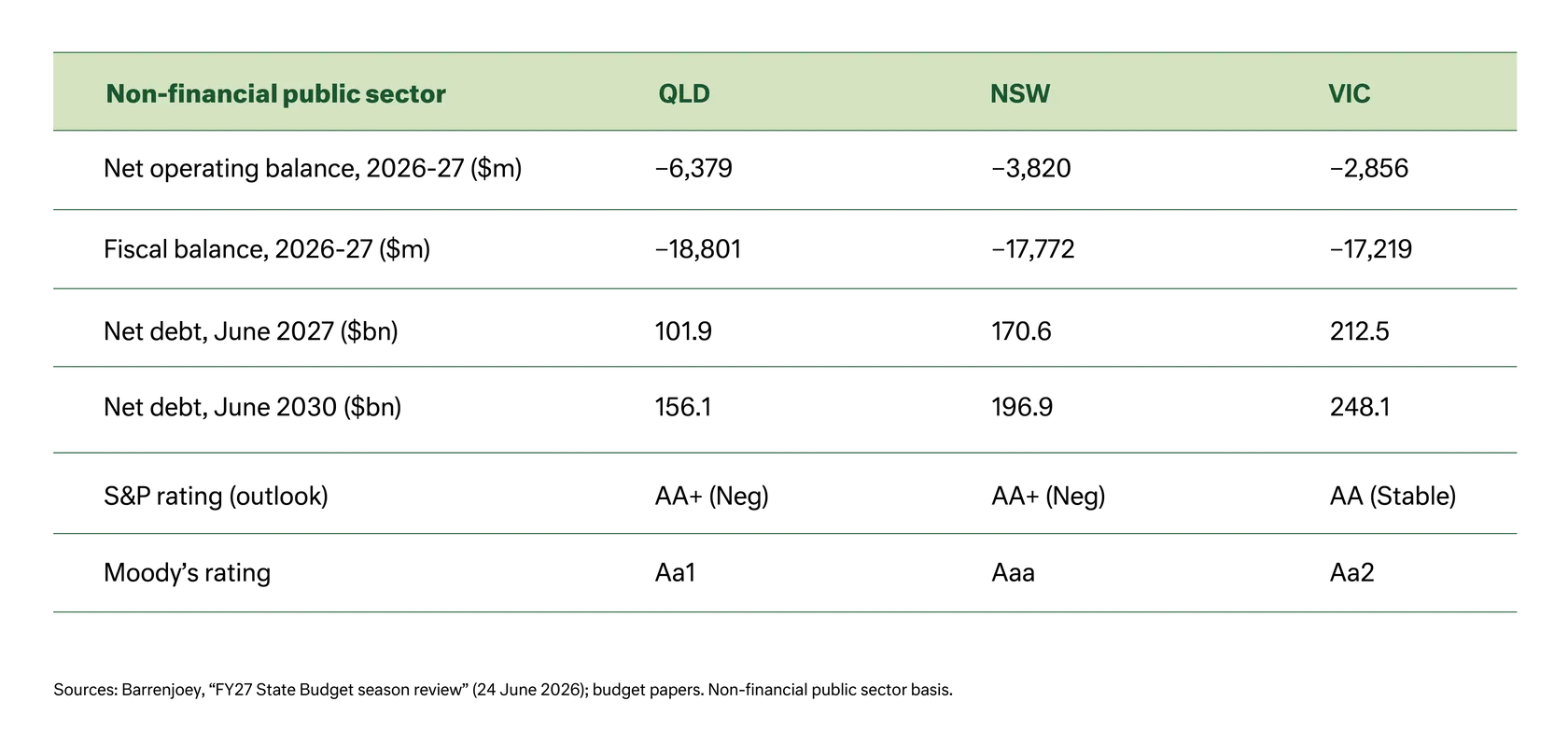
Total debt is forecast to climb from about $142 billion this year to $163 billion in 2026-27 and roughly $216 billion by 2030, past that threshold for the first time, with the interest bill reaching $7.7 billion a year. On a narrower net-debt basis, we see Queensland at $101.9 billion in June 2027 rising to $156.1 billion by mid-2030, the steepest trajectory of the eastern states, up about $54 billion over three years against roughly $26 billion for NSW and $36 billion for Victoria.

Table - Non-financial public sector

Two points temper this. First, Queensland still carries the lowest net debt of the three today, a genuine starting advantage. Second, some of the near-term restraint comes from re-profiling capital works rather than cancelling them: Capex cuts of $4.4 billion in 2025-26 and $3.3 billion in 2026-27, pushed into later years. Part of the debt has been delayed, not avoided, and the Olympic build is still ramping up.

This is where we urge the most caution. The path to surplus leans on average revenue growth of 5.1 per cent over four years, up sharply from 3.4 per cent a year ago, underpinned by bullish coal-royalty forecasts (Treasury is more optimistic than much of the market), a stamp-duty recovery after a one-year dip, and a higher GST share.

Yet the government has promised expense growth of just 2.6 per cent over four years, and only 1.1 per cent in 2028-29, which Barrenjoey ranks as the second least realistic expense outlook of any state. That is a tall order when inflation in 2026-27 is forecast at 3.75 per cent and public-sector wages already sit at about $40.5 billion (38.3 per cent of spending) after rising 5.4 per cent in a year. The public service grew by 8,693 roles in the year to March, yet the budget assumes headcount growth under 1 per cent in 2026, a feat the state has not managed for years.

S&P reiterated its negative outlook on the AA+ rating, calling the fiscal position “very weak.” A downgrade would lift borrowing costs at precisely the moment debt and the Olympic build are peaking. The Treasurer blamed its “inevitability” on the former Labor government. Either way, Queensland is the eastern state where rating risk is most live, and where the cost of getting the forecasts wrong is highest.

For households there is little new, mostly the continuation of existing measures, with none of the registration or toll relief offered south of the border. Opposition Leader Steven Miles’ line that there is “nothing in here for Queensland families” captures the political risk the government has accepted for long-term repair.

For property owners the picture is steadier. With no new taxes, Queensland keeps a more benign state-tax setting than Victoria. Stamp duty, about 28 per cent of the tax take, dips roughly $300 million in 2026-27 to $8.3 billion before recovering strongly, with the four-year take upgraded $4.2 billion; the government blames federal capital-gains and negative-gearing changes for the cooling. One item to watch is the waste levy, forecast to raise an extra half-billion from metropolitan councils over four years, not a new tax, the government insists, but a cost that could reach ratepayers. For those with holdings across states, structuring across entities, debt and asset location remains a more reliable lever than any single budget.

Two themes travel. First, GST: part of Queensland’s improvement comes from a rising share of the national pool, the same dynamic we flagged for NSW, and a slow headwind for states whose share falls. Second, commodities: Queensland’s revenue is unusually geared to coal and LNG prices, so the credibility of its surplus rides the commodity cycle in a way the southern states’ does not.

Queensland’s budget promises surplus at the very end of the decade while total debt heads toward $216 billion and the Olympic build accelerates. The forecasts that hold it together, 5.1 per cent revenue growth, 2.6 per cent expense growth, just 1.1 per cent in 2028-29, are ambitious, and S&P’s negative outlook reflects the risk. Of the three eastern states, Queensland has the lowest net debt today but the steepest trajectory and least headroom, and its revenue rides the commodity cycle.

For investors, the message is the one we have made across this budget season: the headline surplus matters less than the credibility of the path to it. Commodity and Olympic exposure cuts both ways, and careful selection, across credit, equities and property, and across state lines, matters more than any single budget. Fiscal promises and fiscal delivery are not the same thing.

Speak to one of our advisers to learn more: david.clark@cameronharrison.com.au