NSW Budget 2026: Discipline or Deferral?

Wealth Management Solutions
By David Clark, Partner - Investment Management
Posted 29 June 2026

The NSW Budget 2026/27, handed down on Tuesday by Treasurer Daniel Mookhey, is the most fiscally disciplined of the mainland states: over three years NSW has held average expense growth to 3.6 per cent a year, less than half the 8.3 per cent average of the other eight governments. But discipline is not a surplus. Deficits of about $3 billion (2025-26) and $2.3 billion (2026-27) precede the first surplus, a forecast $1.1 billion in 2027-28, beyond the March 2027 election, while net debt climbs toward $196.9 billion by mid-2030. NSW is the better managed balance sheet in the federation, but the result is restraint deferred rather than repair delivered. 

Against our analysis of the Victorian Budget 2026, the contrast is striking. Where Victoria leaned on a dividend from its motor accident insurer to underwrite a token surplus, NSW has done the harder work on spending, and Barrenjoey rates it “best placed” among the states to deliver. We do not want to diminish that. But three things temper the picture: the deficit persists, the surplus sits beyond an election, and the budget still reaches for the same lever we flagged in our Victorian Budget analysis - a billion dollar plus uplift in dividends from a state investment fund. 

The discipline is real; the surplus is deferred.  
In its last full-year budget before the March 2027 election, the government aimed relief at motorists and households. A $601.4 million transport package leads: $435 million for drivers (the weekly toll cap cut from $60 to $50, registration cut $100 for cars) plus a twelve-month fare freeze for 4.2 million users. Other measures span a $1,000 payment for 120,000 public servants, $557 million on electricity bills, $184 million more for family violence services, $632 million for the Thriving Kids disability program and $6.5 billion to electrify buses, with a $1.1 billion contingencies fund behind them that doubles as an election war chest. 

Largely, yes – it is the budget’s most important feature. NSW’s three-year average expense growth of 3.6 per cent is the lowest in the country, achieved by cutting senior executive headcount by 15 per cent (615 roles), freezing MP and senior public-servant pay for two years, and reforming workers’ compensation. However, even disciplined governments overspend. Expense growth actually hit 5.4 per cent this year, well above the 3 per cent forecast, and weaker population growth (1.2 per cent, below the national 1.5 per cent) eases service pressure but reflects a net loss of 21,000 residents to other states, a symptom of housing unaffordability. 

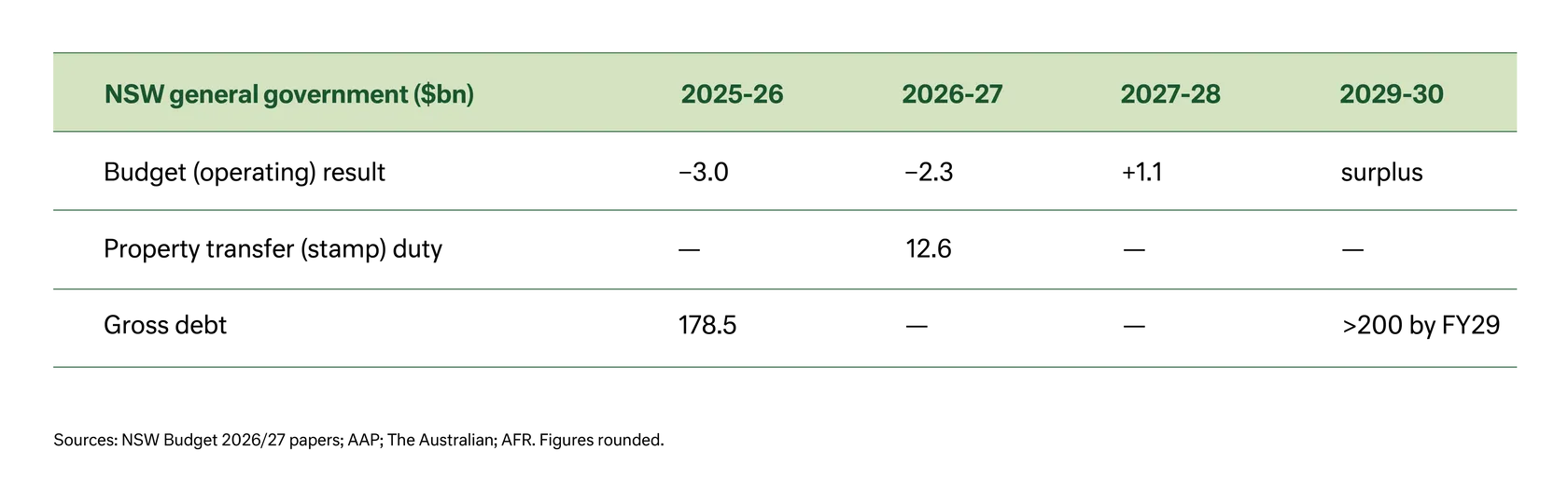
Restraint has not closed the gap, because revenue is deteriorating faster. The Treasurer’s hope for a final deficit of $2.3 billion in 2026-27 which is worse than the $1.1 billion projected a year ago, reflects a near $2 billion slump in property transfer duty to $12.6 billion. The promised surplus ($1.1 billion in 2027-28) depends on a property recovery from late 2027 and the government’s re-election. Sydney University’s Luke Hartigan calls it “ambitious”; we agree – a surplus that lands only after an election, and only if rate cuts and a rebound arrive on schedule, is a forecast, not a fact. 

Table - NSW General Government

Gross debt reaches $178.5 billion this year and breaches $200 billion by 2028-29; net debt rises to $196.9 billion by mid-2030. Large numbers, but smaller than Victoria’s, which is the point worth holding onto.  

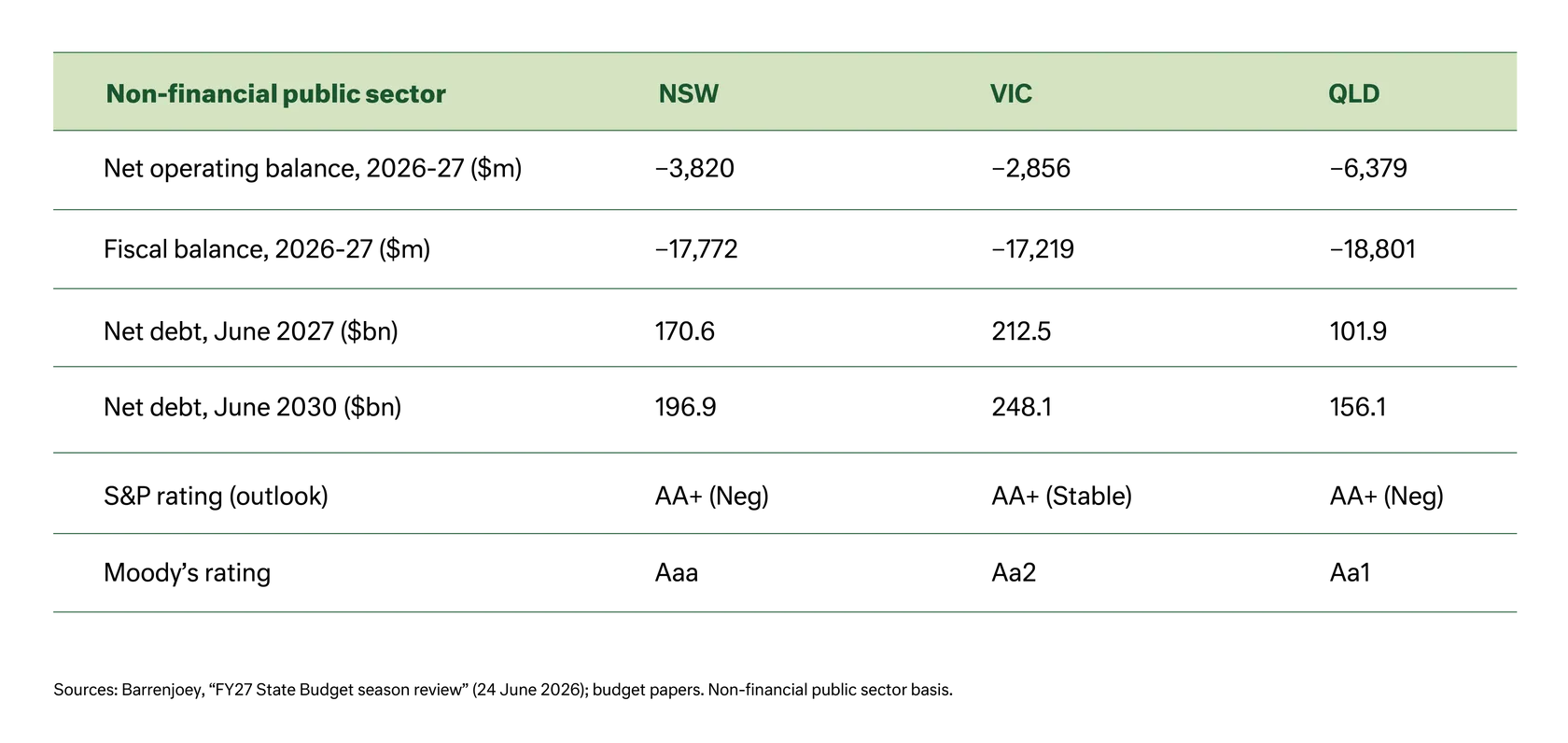
Table - Non-financial Public Sector - NSW, VIC, QLD

NSW carries roughly $42 billion less net debt than Victoria, a gap widening past $50 billion by 2030, with a higher S&P rating (AA+ versus AA) and Moody’s Aaa. But the outlook is negative: S&P warned that NSW must keep its tight rein on spending, and that “any delay in the improvements could pose downside risks”. With growth slowing to 1 per cent while the RBA is still raising rates, debt servicing becomes a larger, stickier claim on revenue. 

Here NSW and Victoria rhyme. Victoria’s recurring TAC dividend props up its operating result; NSW’s equivalent is the OneFund portfolio, described by the Treasurer as a “shock absorber” against the oil shock and now booked to deliver a revised $5.3 billion lift in dividends across the forwards. A growing reliance on distributions from public financial corporations signals a budget more fragile than the headline, one that holds only while those entities can pay. 

Property and business carry much of the revenue load. The budget books an extra $942.9 million in payroll tax over four years and a net $696 million from a tax-integrity program targeting stamp duty and land tax. Businesses using contractors face large bills after Revenue NSW deemed their arrangements too similar to employment - worth attention for any client using contractor or labour hire structures. The 8 per cent foreign purchaser surcharge is removed for large scale build to rent. For those with significant NSW holdings, careful structuring across entities, debt and asset location matters more, not less. 

The surplus pathway leans on a sequence of favourable outcomes. Growth is forecast to slow to 1 per cent in 2026-27, down from 2.25 per cent a year ago, before recovering to around 2 per cent, while inflation of about 3.75 per cent runs above the 2.25 per cent previously forecast. Each assumption is plausible alone. Together, a property recovery, easing rates, a growth rebound and more investment, they require several things to go right at once, after a run of revisions that went the other way. 

Two themes carry beyond the border. First, GST: NSW expects its share of the pool to improve from 2027, a developing headwind for Queensland and Western Australia. Second, inflation: NSW’s handouts and fare freezes are mildly stimulatory just as monetary policy tries to do the opposite, and across every state and a Commonwealth whose spending rose 8.4 per cent, the combined impulse keeps pressure on rates. Semi spreads have not yet diverged, because markets assume the Commonwealth would stand behind any state in distress, reasonable, but not free. 

The Minns government’s pre-election budget is the most disciplined in the country on spending, but it repairs less than the headline implies. A $2.3 billion deficit remains for 2026-27, the first surplus waits until 2027-28 after an election, net debt climbs toward $197 billion and the result leans, as Victoria’s did, on fund dividends and on growth and property assumptions the recent data has not supported. NSW is the relatively well-managed balance sheet, but “relatively” is doing real work, and careful selection across credit, equities and property matters more than any budget headline. Fiscal discipline and fiscal repair are not the same thing. 

Speak to one of our advisers to learn more: david.clark@cameronharrison.com.au

Sourced from:

Photo by iStock