The result is a valuation structure where a small group of firms now carry not only the index, but also the expectations of investors who assume that AI’s rise will continue unchallenged. One reason valuations persist is because of perceived scalability, yet scalability is becoming capital intensive.
The AI Premium – when expensive gets… expensiver
Investment Solutions

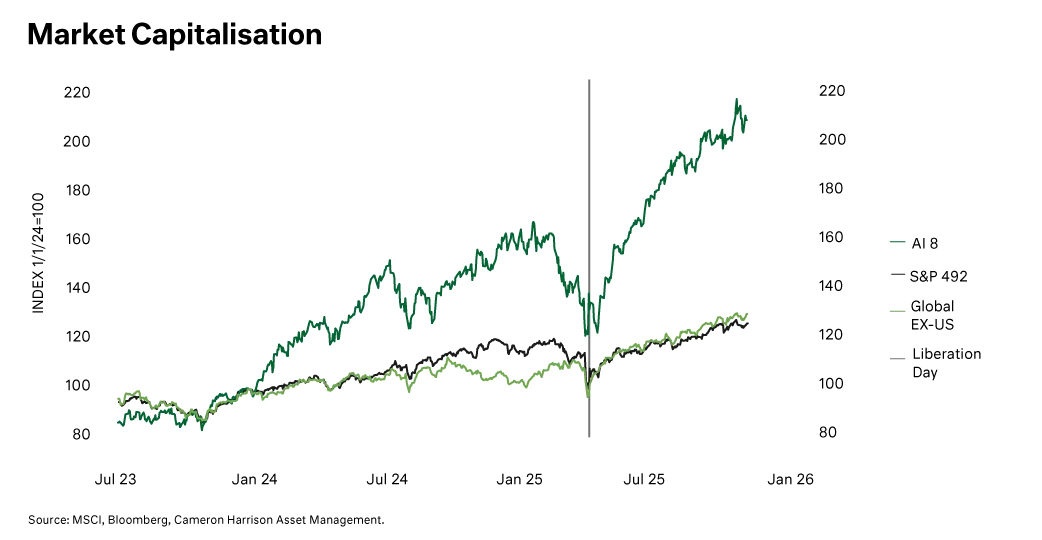
The cloud at the centre of the expanding AI universe US equity markets remain expensive on almost any conventional measure, and a single cluster of companies explains why. Valuations continued to persist throughout 2025 with numerous companies achieving repeated record highs. The chart to the right, showing the market capitalisation of a handful of companies colloquially known as the ‘AI8’ surging to over two times their July 2023 values and far ahead of the remainder of the S&P 500 index, illustrates how much of today’s valuation premium is concentrated in a handful of AI-linked firms. They aren’t leaving the index behind… they’re dragging it along.
Posted 27 January 2026
What once (and only recently) seemed like a capital-light software boom has morphed into one of the largest infrastructure developments in modern corporate history.
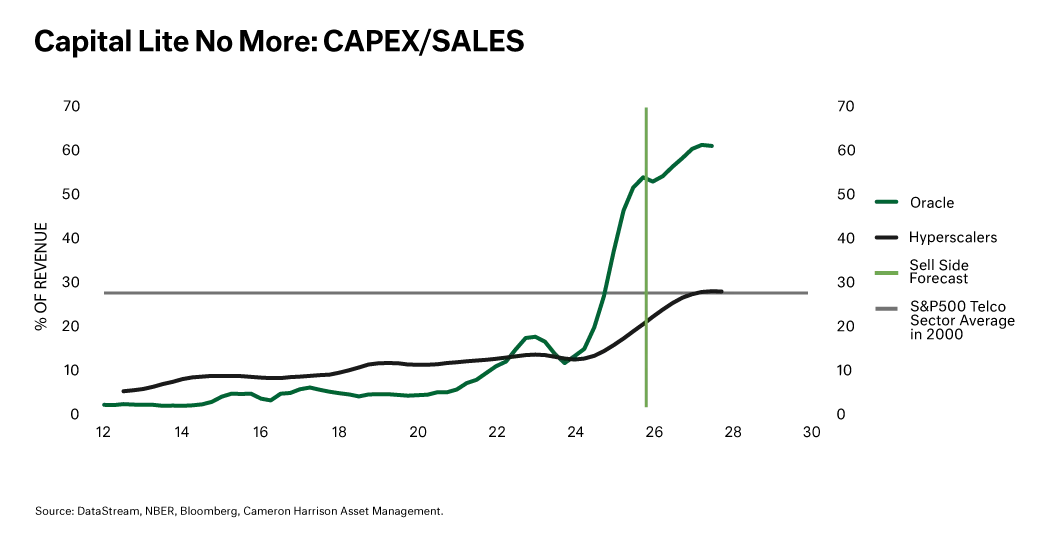
The chart below, shows hyperscaler capex surging toward 25 percent of revenue, levels once associated with ‘old-world’ telecommunication networks.
The comparison is not dissimilar. Just as the dot-com era drove an arms race to lay fibre optic cable in anticipation of a digital future, today’s AI leaders are racing to construct vast compute networks.
More revenue demands more computational power, which demands more hardware, which demands more capital expenditure…
The worry with this analogy is that the unrealistic revenue expectations and ambitious overinvestment of the dot-com era removed discipline and pushed firms to chase scale ahead of returns that ultimately never materialised.
This escalating cost structure is also reshaping strategic alliances. The recent triangular investment pact between Anthropic, Nvidia and Microsoft is telling. AI has become so expensive that even the giants are banding together.
Under the arrangement, Anthropic will scale its large language models on Microsoft’s cloud network using Nvidia’s chips. In return, Microsoft and Nvidia will each commit billions to back Anthropic. Microsoft CEO Satya Natella’s comment that they will increasingly be customers of each other shows a growing circularity in the ecosystem, a bit like a powerboard plugged into itself with no real external source of energy.
When competitors start taking equity positions in one another simply to guarantee compute and chip supply, it shows that scarcity of resources at the top-end is shaping the race.
High investment is not a problem in and of itself, so long as returns stay high as well. But… sustaining those returns becomes more difficult when they are at levels never seen before. Recent modelling suggests that the current wave of AI infrastructure spending through 2030 is so large that, to justify even a 10% return, the industry would need to generate annual revenue of approximately A$980 billion in perpetuity. That is 58bp of global GDP, or the equivalent of every iPhone user paying A$53 per month… forever. The caution is that while AI remains strategically important, the investment cycle is running far ahead of monetisation, and unless revenue ramps up meaningfully, the sector risks returns that fall well short of investors’ expectations.
While none of this rules out the possibility that AI ultimately delivers on its promise, the burden of proof to justify today’s optimism is rising, and makes diversification not just sensible, but essential. With capital demands accelerating and valuations already stretched, investors face the risk that even strong outcomes fall short of the narratives currently priced in.
Watch Matt's full analysis in the video below:
Speak to one of our advisers to learn more:
matthew.nolan@cameronharrison.com.au
Sourced from:
Photo by iStock