One Plan, Two Strategies

Wealth Management Solutions
By Paul Ashworth, Managing Partner, Chief Investment Officer
For most private business owners, business succession and wealth succession are not two problems but one. The great majority of family wealth typically sits inside a single, illiquid, owner-dependent asset, the business. Planned separately, the two work against each other. Planned as one owner first plan containing two strategies, they secure two legacies: the business that was built, and the wealth and family it was always meant to provide for.
Posted 09 July 2026
  • Business succession and wealth succession are one integrated challenge. For most private business owners, the majority of family wealth sits inside a single illiquid asset, the business, so separating plans creates structural conflict rather than clarity. 

  • Timing and planning discipline determine outcomes. Global research suggests trillions of dollars of intergenerational wealth transfer is underway, yet most business owners still exit without a documented succession plan, increasing the likelihood of forced closure or value destruction. 

  • The critical variable is funding the principal. Every succession pathway is ultimately a funding mechanism for the owner’s retirement or next stage of life, making funding-gap clarity the starting point for any effective transition strategy. 

Cameron Harrison’s position, held by our Partners across more than forty years advising Australian business owners, is that the business legacy and the wealth and family legacy belong inside a single, owner first plan containing two strategies: one for the business and its succession, one for the wealth and the family. Both are held to one timeline, integrating tax effectiveness, asset protection and economic management across the whole of a client’s wealth. The ‘hinge’ on which both strategies ‘swing’ is the question most owners leave until last: how the principal is funded out of the business. 

The backdrop is a generational handover without precedent. International research estimates around US$30.9 trillion will pass between generations by 2033. In Australia, an estimated A$3.5 trillion will move over the next twenty years. Roughly 48% of Baby Boomer business owners intend to exit within five years, yet only about one in five holds a documented succession plan. The default outcome is sobering, of some 510,000 US small and mid-sized business exits in 2022, research estimates more than nine in ten simply closed. Without a plan, the most likely fate of a business is not a legacy, it is closure. 

Bar chart- the default outcome without a plan

An owner who plans the business and the family wealth separately faces three predictable failures.  

  1. Concentration risk goes unmanaged, as wealth stays locked in the business until a sale that may never arrive on the owner’s terms.  

  1. The transition becomes a transaction, negotiated once under time pressure rather than built and de-risked over years, and 

  1. The family is addressed reactively, often only when conflict, illness, divorce or death forces the issue. 

Table - Two plans vs one aligned plan - wealth strategy

Our experience, and now overwhelmingly the research, conclude:

1. Succession is a process, not an event

Succession in family businesses is realistically a three to eight year journey (longer with family generational transition), yet most families start late, and poorly managed transitions are estimated to destroy on the order of US$1 trillion in value globally each year.  

2. The hardest part is letting go

Research implicates the outgoing family business owner, not the heir. Value is built long before any sale, from real operating performance rather than financial engineering. And “family wealth” is broader than money, encompassing knowledge, relationships and legacy that compound across generations. 

Bar Chart - Inherited wealth

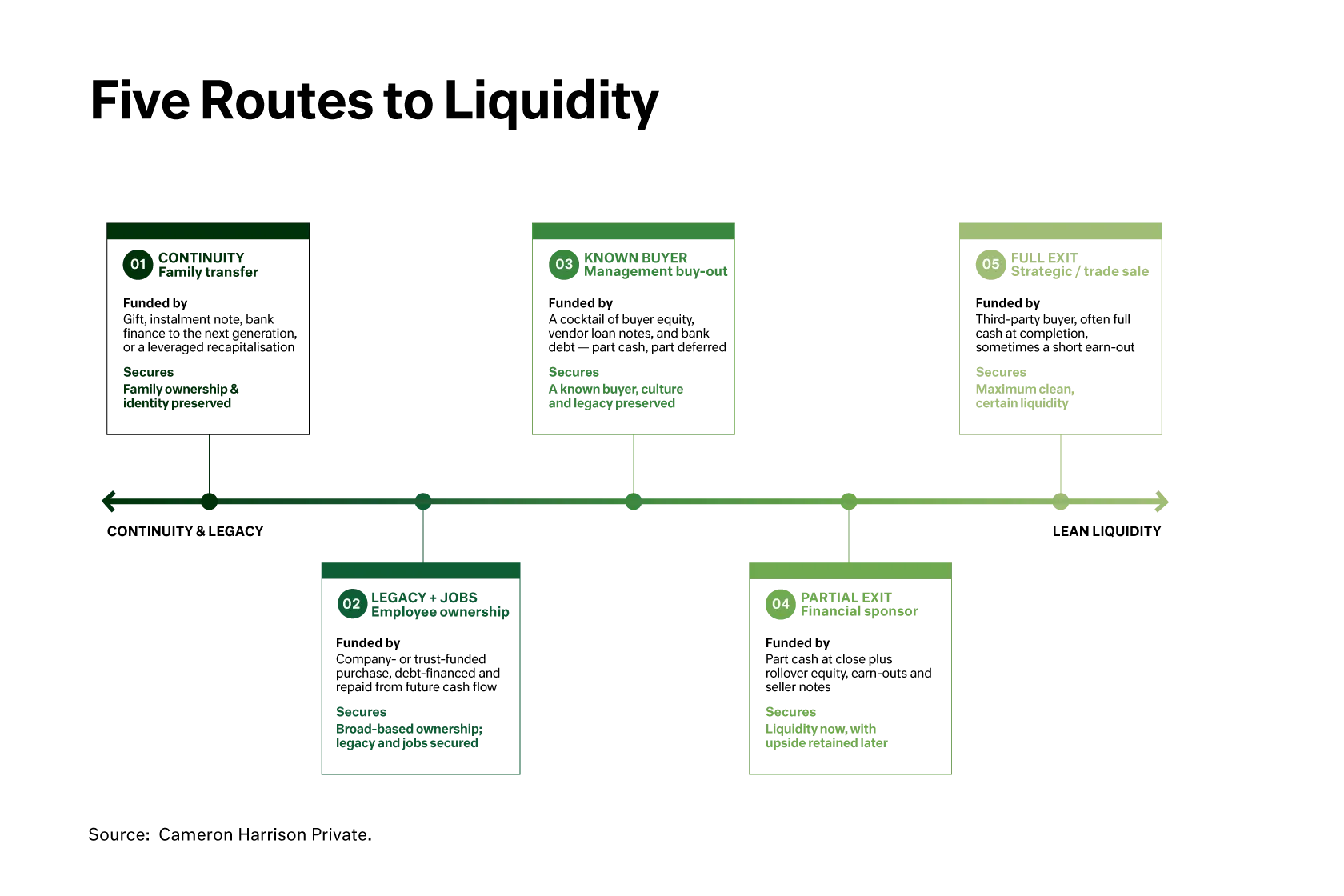
Here is the question that quietly determines whether both legacies survive: when the owner steps back, where does the money come from to fund the rest of their life, and at whose cost? Every succession route is also a funding mechanism for the principal. The disciplined starting point is not a valuation or an offer but the owner’s own number, the funding-gap analysis: what after-tax income will fund the life the family intends, and therefore what must the business deliver to close the gap? Broadly, the principal can be funded through five routes, rarely in pure form and most powerfully in combination. 

Diagram - Five routes to liquidity

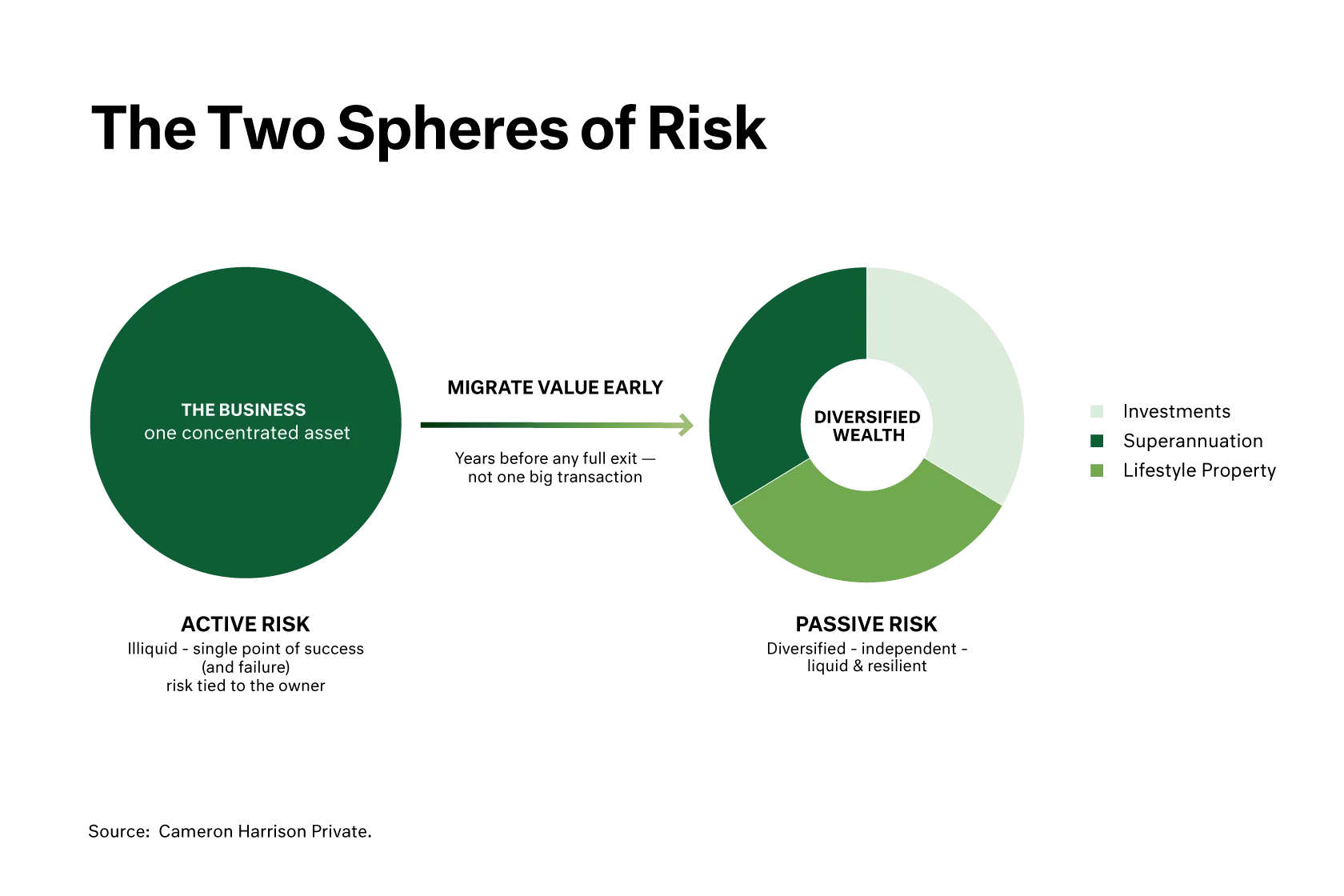
The thread through every route is the same concern owners themselves rank first: too much wealth trapped in one asset. The aligned plan attacks this early, migrating value from the active sphere (the business) into the diversified, independent passive sphere (investments, superannuation, property) years before any full exit, rather than betting everything on one transaction. 

Diagram - Two spheres of risk

A case study in running business, wealth and family strategies as one plan

The Situation

A husband and wife owned a successful manufacturing business. Out of the blue, they received an unsolicited offer: $6 million for 75% of the company. It felt like easy money, and they were minded to accept. 

Two questions surfaced the real picture. Why were they selling? They had no clear answer. What was the business worth? There was no valuation, and the offer implied a whole of business value of only about $8 million, a number no one had ever tested. 

The Problem Beneath the Offer

The willingness to sell wasn’t about price. Beneath it sat an unresolved conflict among the four people central to the business: the managing director and two adult sons. The offer was attractive largely because it promised an exit from a problem nobody had named. Selling to a third party would have locked that conflict into the ownership structure rather than resolving it, at a price set by a far better informed buyer. 

The Approach

Rather than negotiate, the advice was to pause and do the work first. An issues workshop brought the conflict into the open and separated the family questions from the commercial ones. From there, three workstreams ran as one plan. 

The conflict was resolved, the directors and sons reached a workable settlement, removing the pressure behind the hasty exit. 

The business was independently valued near $12 million, roughly 50% above the offer’s implied figure. 

It was then prepared for sale and structured for optimal net proceeds, with attention to deal structure and after-tax outcomes, not headline price alone. 

The Outcome

The business sold for over $16 million and the owners’ personal funding was designed from the outset, not left to whatever fell out of the deal. That meant the couple knew exactly what they needed to fund the rest of their lives before they signed. 

Why it Matters

The point is not the multiple. It is that the business, wealth and family strategies were run as a single plan. Run separately, the conflict would have followed the family into the next chapter and the principals’ funding would have been stumbled into. Designed together, the financial result tends to look after itself. 

Bar chart - Offer vs realized exit

The owners who succeed twice, in the business and in the wealth they pass on, stop treating the two as separate. They diversify before they have to, structure ownership while they still can, decide in advance how the principal will be funded, design the family’s role before conflict forces it, and align every decision to a single horizon. 

One plan. Two strategies. The business you built, and the wealth and family it was always meant to secure. 

Is business succession the same as wealth succession?

Yes - for most private business owners, business succession and wealth succession are effectively the same challenge. This is because a large proportion of family wealth is typically concentrated in the operating business. Treating them separately can create misaligned decisions, particularly around timing, valuation and exit strategy. A single integrated plan ensures both the business transition and the family’s financial future are designed together. 

Why do most business succession plans fail?

Most succession plans fail because they are treated as a one-off transaction rather than a long-term process. Owners often delay decision-making, underestimate the complexity of family dynamics, or focus only on valuation and sale rather than structure and timing. As a result, transitions are often compressed under pressure, which increases risk and can significantly reduce realised value. 

What is meant by funding the principal in succession planning?

Funding the principal refers to how the business owner’s post-transition lifestyle is financed. It is the key question that links business succession with personal wealth outcomes. Every succession pathway effectively determines how value is extracted from the business over time. Without clarity on this funding gap early in the process, decisions around timing, structure and exit strategy can become reactive rather than planned. 

What is a funding-gap analysis in succession planning?

A funding-gap analysis defines how much after-tax income the owner will require once they step away from the business, and what level of capital is needed to support that outcome. It becomes the anchor for all succession decisions, including timing, deal structure and ownership transition, because it clarifies what the business must ultimately deliver to fund the principal. 

When should a business owner start succession planning?

Succession planning typically needs to begin years before any intended exit, often over a three to eight year timeframe. Starting early allows owners to reduce concentration risk, prepare the business for transition, and align family and ownership structures without time pressure. Late planning generally limits options and increases the likelihood of value loss. 

Speak to one of our advisers to learn more: paul.ashworth@cameronharrsion.com.au