
Australia’s Property Taxes: Reasonable in Principle, Abusive in Practice
Wealth Management Solutions
By

Paul Ashworth, Managing Partner

Australia’s housing debate is usually framed around interest rates, cost inflation, population growth and planning delays. These are critical variables, but they do not fully explain the growing reluctance of long-term capital to engage with residential development and property investment. A less visible, but increasingly decisive factor is the structure - and growth trajectory - of state-based property taxes.
Posted 27 January 2026

In principle, state taxation of property is entirely reasonable. Land is immobile, difficult to offshore and benefits directly from public infrastructure. Property taxes can therefore provide a stable and equitable revenue base for state governments. The issue is not the existence of these taxes, but their increasing scale and breadth, cumulative burden and constant evolution.

Across Australia, property has become the tax base of first and last resort. Stamp duties, land taxes, foreign purchaser surcharges, rezoning levies and infrastructure charges are not only growing in quantum, but changing frequently. This creates a moving minefield for investors - one that does little to support the patient capital required to address Australia’s housing shortage.
Stamp duty remains the most visible example of this tension. As a transaction tax, it is simple to administer and delivers immediate revenue. It is understandable why states continue to rely on it.

Yet over time, stamp duty has expanded beyond a modest transaction charge into a major impost on capital deployment. Rates have crept higher, thresholds have failed to keep pace with inflation, and concessions have become increasingly complex and targeted.

For households, this discourages mobility. For investors and developers, it raises the hurdle rate for capital deployment. A long-term investor acquiring a $50 million development site or build-to-rent asset can face stamp duty costs measured in millions - capital that earns no return and cannot be recovered. Ultimately it is reflected in the price, but with constant increases and new imposts, determining value becomes vexed and uncertain.

In isolation, stamp duty may be defensible. In combination with escalating holding taxes and development levies, it materially changes the investment equation.

Land tax is often held up as the “better” tax - and in principle, it is. It does not penalise transactions and grows with land values. However, the extent and expansion of land tax regimes across several states has shifted it from a modest holding cost to a material drag on returns.

Over the past decade, states have:

  • Lowered thresholds

  • Increased marginal rates

  • Expanded aggregation rules

  • Introduced or increased foreign owner surcharges

These changes have often been implemented incrementally, but their cumulative impact is significant. In Victoria and New South Wales, top marginal land tax rates - once the preserve of very large landholdings - now apply to increasingly common investment portfolios. For foreign investors, effective annual land taxes can approach levels that rival equity dividend yields.

Again, the issue is not land tax per se, but its ever-expanding role as a revenue backstop.

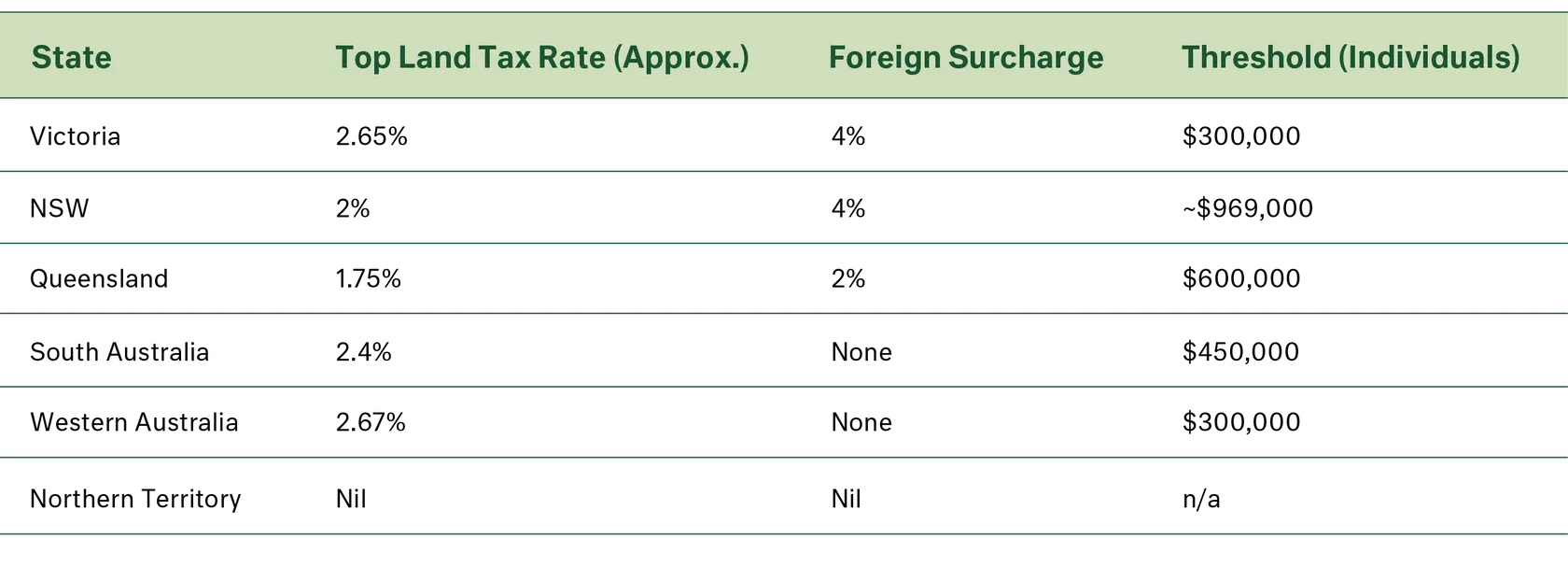
The structure of land tax differs substantially across states, particularly in thresholds, aggregation rules and surcharge regimes.

Victoria and New South Wales have progressively increased reliance on land tax, particularly for foreign owners. Queensland and South Australia have taken a more moderate approach, while the Northern Territory stands apart with no land tax at all.

State governments face structural fiscal pressures. Health, education and infrastructure costs continue to rise, while politically sensitive taxes - such as payroll tax and consumption levies - attract resistance. Property, by contrast, is visible, immobile and politically convenient.

The result is a pattern:

  • Budget pressure emerges

  • Property taxes are adjusted

  • Thresholds are frozen or lowered

  • New surcharges or levies are introduced

This has occurred repeatedly across jurisdictions, often with limited consultation and little long-term signalling. From rezoning taxes to vacancy levies and new annual property charges, property has increasingly been used as the default fiscal adjustment mechanism.

For long-term investors, this unpredictability is more damaging than the headline tax rate itself.

Property investment - particularly housing and development - requires long time horizons. Capital is deployed upfront, returns are realised slowly, and risk is managed over decades, not quarters.

Yet state property tax regimes are now in near-constant flux:

  • Stamp duty structures change

  • Land tax thresholds shift

  • New surcharges are introduced

  • Development levies are recalibrated

  • Transitional arrangements are revised

This creates a moving minefield for investors attempting to model long-term returns. Feasibility assessments completed today may be materially undermined by tax changes before a project reaches completion.

This is not conducive to attracting the stable, patient capital required to fund housing supply at scale.

Capital is not ideological - it is pragmatic. As the risk-adjusted returns on property investment become less certain, alternative asset classes become more attractive.

Increasingly, investors are reallocating toward:

  • Listed equities, where tax settings are stable and liquidity is high

  • Private equity, where capital structures can adapt more flexibly to policy change

  • Private credit, where returns are contractual, duration is shorter and tax risk is lower

These asset classes offer something property increasingly struggles to provide: predictability.

When long-term capital compares a leveraged property investment subject to evolving state taxes with a private credit instrument offering stable yields and limited policy risk, the choice is not irrational - it is disciplined.

This dynamic is particularly striking given Australia’s housing shortage. At a time when governments are urging institutional capital into build-to-rent, social housing and large-scale residential development, the tax settings applied to property tell a different story.

Housing supply requires:

  • Long-dated capital

  • Stable policy frameworks

  • Predictable after-tax returns

Yet the current trajectory of state property taxation undermines each of these conditions. The paradox is clear: governments seek more housing investment, while simultaneously increasing the fiscal uncertainty attached to property ownership.

None of this argues for abolishing state-based property taxes. Their underlying principles are sound. What is required is restraint, coordination and predictability.

A more supportive framework would include:

  • Clear long-term signalling on property tax settings

  • Fewer ad-hoc adjustments driven by short-term budget needs

  • Greater reliance on stable, broad-based taxes rather than episodic property levies

  • Recognition that capital has alternatives - and will use them

Property should be taxed, but not treated as the perpetual fiscal shock absorber of state budgets.

Australia’s property tax system is not broken in concept, but it is becoming strained in execution. The constant expansion and recalibration of state-based property taxes is eroding confidence among the very investors needed to fund housing supply.

Capital does not demand concessions - it demands certainty. Without it, investment will continue to flow toward asset classes offering clearer rules and more stable outcomes.

At a time of chronic housing undersupply, that should give policymakers pause. The question is no longer whether property can bear more tax, but whether Australia can afford the investment consequences if it does.

Speak to one of our advisers to learn more: paul.ashworth@cameronharrison.com.au

Sourced from:

Photo by iStock