
Real Rates are Back: What a Regime Change in Interest Rates Means for Your Wealth

Investment Solutions
By Paul Ashworth, Managing Partner, Chief Investment Officer
The US 10-year Treasury yield touched 5% this week for the first time since 2023. The Australian 10-year is above 5.3%, a level not seen since 2011. The more important development sits behind the headlines: after fifteen years of very low rates, investors are again being paid a real return on capital. That has consequences for how a family's wealth is structured.
Posted 24 September 2026
  • Real (after-inflation) bond yields in the US and Australia are around 2.5%, the highest since before the GFC. The move since February has been almost entirely a rise in real yields, not inflation expectations.  

  • Markets agree on the facts and disagree on the cause: a temporary growth overshoot, or a permanent reset to a higher 'neutral' rate. The allocation answer does not depend on picking a winner.  

  • Cash and short-dated securities have moved from residual holdings to core ones, and inflation-linked bonds have attractive positioning attributes. Equity returns will come from earnings, not from rising multiples.  

  • Australian investors face a specific problem: the RBA is tightening into a productivity slump, and the ASX trades on a growth multiple without growth earnings.  
On 14 September the US 10-year yield printed 5.01% before closing just under 5%. Ten-year yields are up roughly 90 basis points this year in the UK, France and Japan, 80 in the US and 60 in Australia. Brent oil touched US$110 on the closure of Saudi Arabia's East-West pipeline. And for the first time since 2006, the central banks of the US, UK, Australia, the Euro Area and Japan are all raising rates at the same time.  

What matters is the composition of the move. Of the roughly one percentage point rise in the US 10-year bond rate since the Gulf conflict began in February, about 90 basis points is a rise in the real yield. Only 10 basis points is higher inflation expectations. Markets are not pricing an inflation problem; they are repricing the cost of capital.  

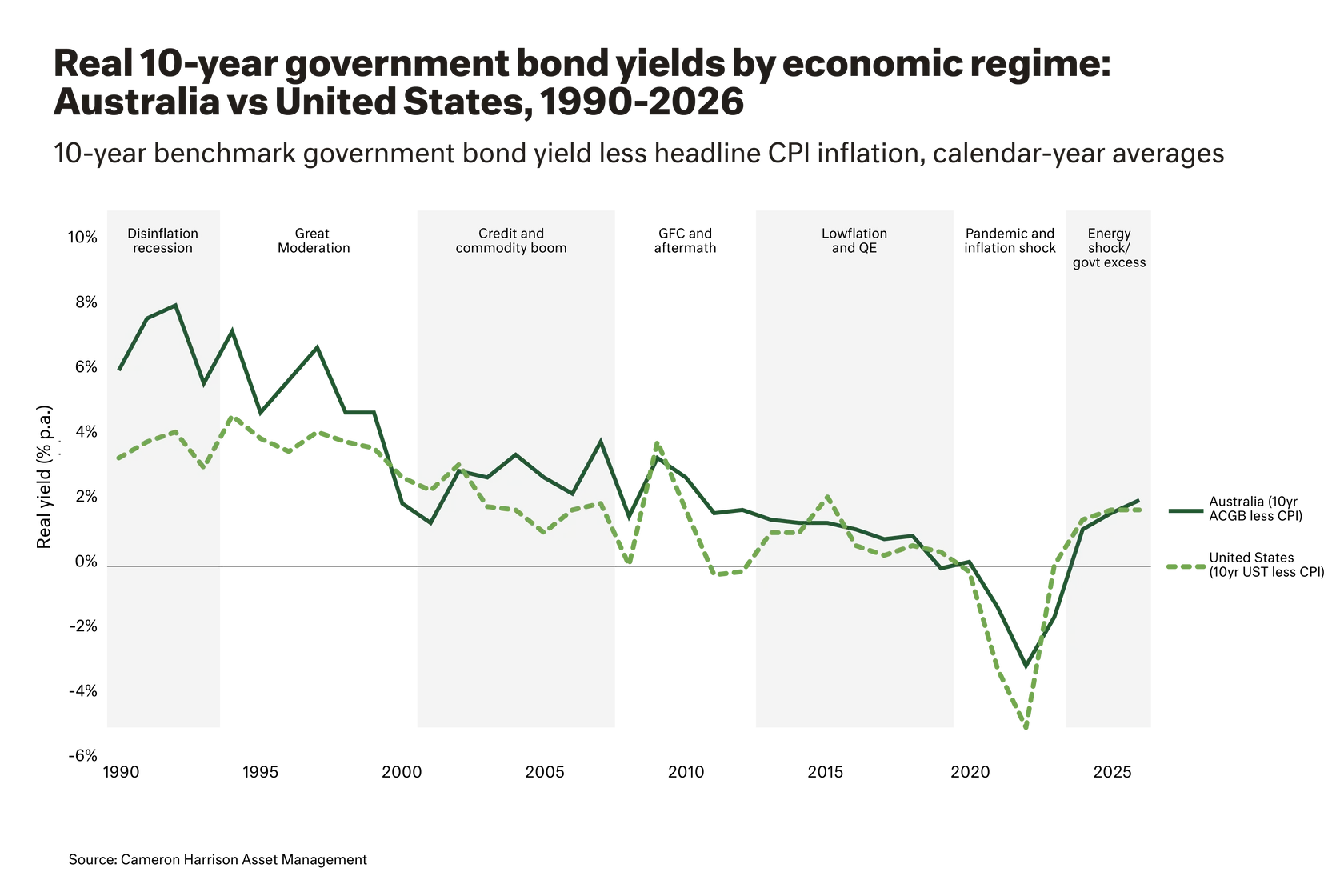
That distinction matters a great deal. When real yields fall, everything with a long-dated cash flow gets more valuable: growth stocks, private equity, property, long bonds. When real yields rise, the effect reverses. Between 2011 and 2021 the US real 10-year yield sat at or below zero. It is now about 2.6%, a swing of more than 350 basis points in the price of money, most of it in four years.  

We have spent some time working through the evidence. The facts are not in dispute; their interpretation is, and the disagreement falls into two camps.  

The structural view is that the post-GFC 'savings glut' that produced near-zero real rates is over. Governments are running deficits of 3% to 8% of GDP with no plan to close them, corporate capital spending has revived, and the neutral rate has risen back towards its pre-2008 level. On this reading a US 10-year at 5.5% is a fair level rather than an overshoot. For equities, the 4% to 6% yield zone is where rising rates start to bite, and the equity risk premium, the extra return for owning shares over bonds, is currently about zero.  

The cyclical view is that the long end has overshot on strong growth (US GDP is tracking 4% to 5% annualised) and a supply-driven inflation pulse from tariffs, energy and AI that is now peaking. Fair-value models put the US 10-year closer to 4.3%, so today's 5% is roughly a full standard deviation above. Equities, on an equal-weighted basis, have already absorbed the shock, and sell-offs are a chance to add duration and technology.  

The forecasting community has split along the same line, and for most of this year the consensus has been wrong in the same direction: too low. Most strategists now concede the risk to their own forecasts remains to the upside.  

Our view is that both camps can be right at once. Real yields can be cyclically stretched by 50 to 70 basis points and still be structurally higher than the 2010s. Even the cyclical camp's own long-run work shows core inflation trending higher towards the end of the decade, which is in substance the structural argument. Our conclusion is not to pick a side, but to build a portfolio that is rewarded under either outcome.  

Cameron Harrison’s Partners have advised families through every real-rate regime since the early-1990s recession. Three lessons stand out.  

Bar graph - Real-10 year government bond yields by economic regime

First, the level of real rates matters less than the reason they are moving. Real yields near 2% coincided with a bear market (2000 to 2002), a bull market (2003 to 2007), a crash (2008) and another bull market (2023 to 2025). Rates rising on strong growth rarely hurt equities until the level bites. Rates falling on collapsing growth always did.  

Second, the 60/40 portfolio was a product of its period, not a fixed rule. It worked from 2000 to 2021 because shocks were growth shocks and bonds rallied whenever shares fell. In 2022 the shock was inflation, both legs fell together, and a balanced portfolio lost 16% to 17%, its worst year since 1937. The 2026 mix of an energy shock, a hiking Fed and a rebuilding term premium is the 2022 configuration, not the 2010s one. Long bonds only hedge equities if the next shock is a growth shock.  

Third, starting real yields are the best single predictor of future real returns. Buying inflation-linked bonds at 2.5% or more real (2000, 2007, late 2023) produced positive real returns in every subsequent five-year window. Buying them at zero or below (2012, 2020 to 2021) produced losses. Real yields are at that level again.  

Australia has its own version of this story, and it is less comfortable. Real household income per head has flatlined since 2022. Real wages are back at 2015 levels. Productivity has not grown since 2019. Yet nominal wages are rising above 3%, which, without productivity growth, will ultimately show up as inflation. That is why all four major banks now expect the RBA at 4.60% by November, and why the cash rate could reach 5.00% in 2027.  

The equity market has not priced this. The ASX trades on about 20 times forward earnings for expected earnings growth of roughly 7% and falling. Global markets ex-Australia offer 20%-plus growth on a similar multiple. We are paying a growth price for value-like growth, and the franking credit does not close that gap.  

Property is the transmission channel to watch. Australian households carry more floating-rate mortgage debt than any in the G10, so each rate hike bites faster here than in the US. House prices are already softening. Meanwhile the Australian dollar, near 71.5 US cents, enjoys something we have not seen since 2018: positive carry against the US (hedging offshore assets back into Australian dollars now adds to return rather than detracting from it.)  

None of this is a forecast, and none of it is personal advice. But the disagreement itself points to a portfolio design, one that is rewarded in each of the scenarios and does not suffer permanent loss in any of them.  

Interest Income
  • Cash, short-dated bonds and floating-rate notes are core, not residual. Real cash of about 1% in Australia, and rising, is the most attractive risk-adjusted return on offer since 2008. Floating-rate notes add to this: their coupons reset with the cash rate, so they carry almost no duration risk and are paid more with each hike the RBA delivers. Holding little cash is a bet on one scenario; in the other two, cash is the holding one is least likely to regret.  

  • Duration is held as a barbell rather than at a single maturity. Two-year bonds at 4.65% capture most of the yield with none of the term-premium risk. A smaller position in the ten-year buys the recovery if the cyclical camp is right. We would extend duration only once the Fed has clearly finished tightening.  

  • Credit: investment-grade corporate and bank paper, floating rate where available, alongside senior, highly rated securitised debt. We would stay away from lower-rated tranches, where the household-leverage risk described above is concentrated.  

  • Inflation-linked bonds at 2.5% real have attractive positioning attributes in this environment. They secure a real return above trend per-capita growth, and their return is defined in purchasing power, which is the measure that matters for wealth preservation.  

Equities
  • Earnings quality over multiple expansion. Returns will come from profit growth minus some de-rating, so balance-sheet leverage and durability of earnings matter more than they have since 2007. Equal-weight over cap-weight, global over Australian, and hold technology as earnings stocks rather than as duration or growth stocks.  

Property
  • Listed property over unlisted until private valuations catch up with a 2.5% real bond yield. A 4.5% cap rate against a 2.6% real yield is half the risk premium it was in 2012.  

We are watching six indicators to judge which scenario is unfolding: the US 10-year bond rate against a fair value of about 4.3%; the 10-year term premium (about 1%); five-year-forward inflation breakevens (2.3%); US households' long-run inflation expectations (3.4%); the gap between realised US earnings growth (35%) and what the macro model implies (8%); and Australia's trimmed-mean inflation (3.6%, next print 30 September). The RBA meets on 29 September, the UK Budget lands on 28 October and the US midterms on 3 November.  

For fifteen years, the absence of alternatives did the heavy lifting in portfolios. Owning risk was rewarded because cash paid nothing. That period is over. Today fixed income competes with equities for the marginal dollar, and every equity allocation has to earn its place through earnings rather than by default.  

None of this is cause for alarm. A positive real return on safe assets is the normal condition of a functioning capital market; the 2010s were the exception. But a portfolio built for the last regime is mis-specified for this one. The families who navigate this well will treat their wealth as a business, revisit its strategy when the environment changes, and resist picking a side in a debate the evidence has not yet settled. That is the discipline we apply with our clients.  

What is a real interest rate?

A real interest rate is the nominal yield on a bond less expected inflation over its life. It is the return an investor earns in purchasing power. As at 15 September 2026, real 10-year yields in the US and Australia are around 2.5%, the highest since before the GFC.  

Are inflation-linked bonds worth holding at a 2.5% real yield?

In our view they have attractive positioning attributes at this level. Historically, buying inflation-linked bonds at real yields of 2.5% or more has produced positive real returns over the following five years, and their return is defined in purchasing power. How much to hold depends on a family's objectives and the rest of the portfolio.  

Should Australian investors hold more cash while the RBA is raising rates?

Cash, short-dated bonds and floating-rate notes are now core holdings rather than residual ones. With the cash rate expected to reach 4.60% by November 2026, they offer a positive real return with little duration risk. Holding very little cash is a bet on one scenario; in the others, cash and low duration, floating-rate notes are the holdings one is least likely to regret.  

Speak to one of our advisers to learn more: paul.ashworh@cameronharrison.com.au