Beyond the Headlines: Inside Division 296

Wealth Management Solutions
By James Cummings, Portfolio Adviser Anne-Marie Tassoni, Partner - Private Wealth Management

Division 296 introduces additional tax on super balances above $3 million from July 2026. Understand the thresholds, cost base reset, and what a measured approach looks like.
Posted 08 April 2026

After years of consultation, iteration, and political negotiation, Division 296 is now law. Passed by both Houses of Parliament in March 2026, it represents the most significant structural change to superannuation taxation in nearly a decade. 

For those with total superannuation balances above $3 million, the new regime introduces additional tax on realised earnings, but it does not displace the fundamental advantages that superannuation provides. The task now is not reaction but understanding. 

This article sets out how Division 296 works in practice, what has changed from earlier proposals, and why a measured, whole-of-wealth approach is likely to produce better outcomes than a narrow focus on any single tax measure. 

Division 296 at a Glance
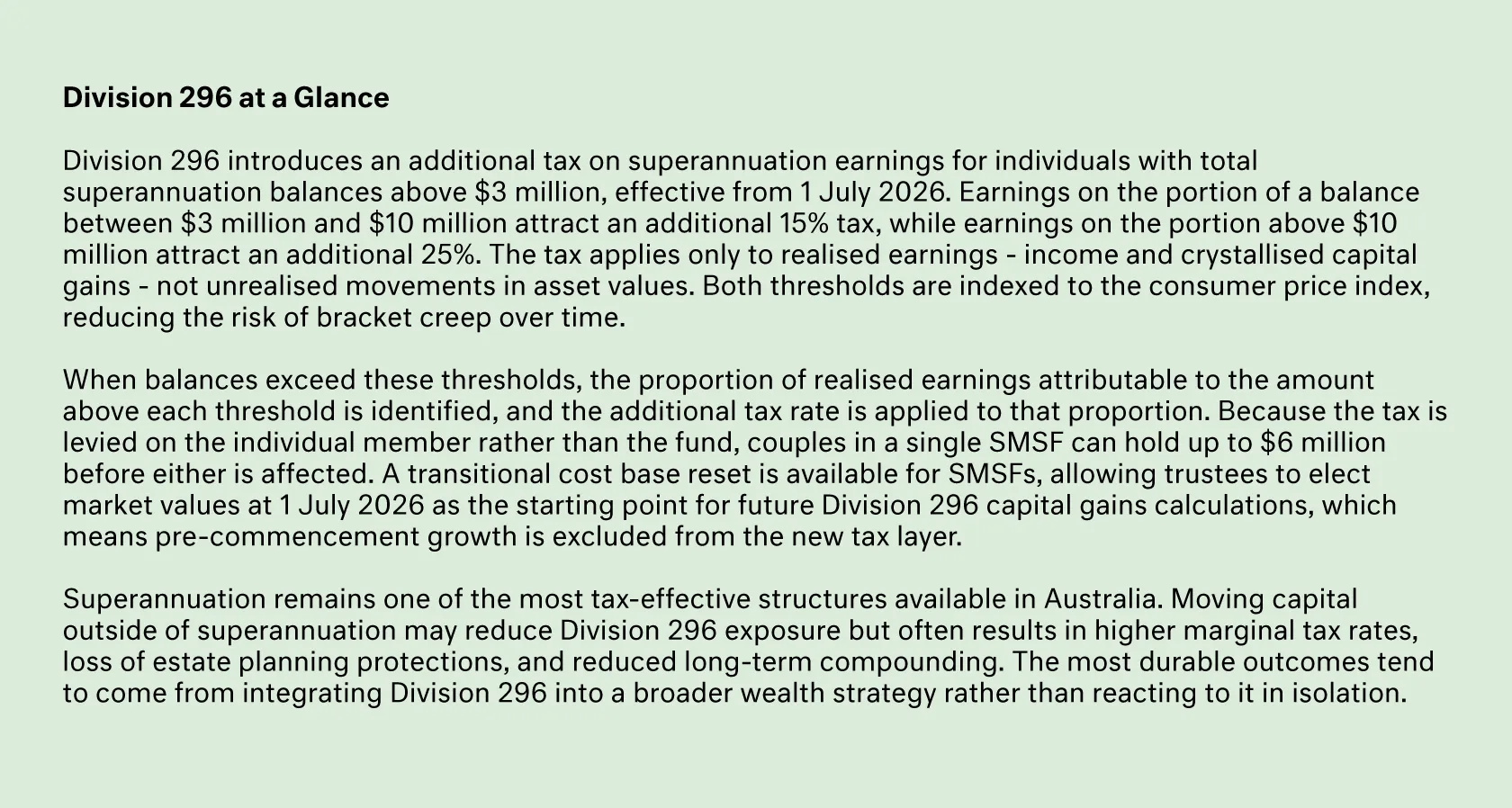
  • Division 296 applies an additional tax on realised superannuation earnings for individuals with balances above $3 million, with a higher rate for balances above $10 million, effective from 1 July 2026. 

  • The tax applies only to realised earnings - income and crystallised capital gains - and both thresholds are indexed to CPI, addressing two of the most significant concerns from the original proposal. 

  • Superannuation remains highly tax-effective relative to alternative structures, and withdrawing capital to avoid Division 296 may result in worse overall tax and estate outcomes. 

  • SMSF trustees can elect a cost base reset to market value at 1 July 2026 for Division 296 purposes only, but the election is irrevocable and applies to all fund assets. 

  • The first year of operation has a transitional rule based solely on the balance at 30 June 2027, providing a clear planning window before the regime is fully operational. 

Division 296 introduces a tiered additional tax on superannuation earnings for individuals whose total superannuation balance exceeds $3 million. The tax sits on top of the existing superannuation tax framework, where earnings in accumulation phase are taxed at 15% and are tax-free in pension phase, and applies regardless of which phase a member’s interests are held in. 

At its core, the regime identifies the proportion of a member’s balance above each relevant threshold, calculates the share of realised earnings attributable to that proportion, and applies the additional tax rate accordingly. When a member’s balance grows beyond the $3 million mark, the additional tax applies only to the earnings on the excess, not the entire balance, which means the effective additional tax burden scales with the degree to which the threshold is exceeded. In practice, this often shows up as a relatively modest additional liability for balances just above $3 million, increasing meaningfully only as balances move further beyond the thresholds. 

Importantly, the final legislation passed in March 2026 applies exclusively to realised earnings: dividends, interest, rent, and capital gains that have been crystallised. The earlier proposal to tax unrealised capital gains, which drew sustained criticism from industry and practitioners, was removed during the legislative process. Both thresholds are also now indexed to the consumer price index, with the $3 million threshold increasing in $150,000 increments and the $10 million threshold in $500,000 increments.

If your total superannuation balance is below $3 million, Division 296 does not apply to you. 

The threshold is assessed at the individual member level, not the fund level. When a balance crosses $3 million, the proportionate share of realised earnings on the excess attracts the additional tax, which means the impact increases gradually rather than applying a sudden step change. In practice, this often shows up as couples in the same SMSF being able to hold up to $6 million in combined balance before either member individually triggers the Division 296 thresholds. 

It is worth noting that “total superannuation balance” includes all interests across all funds; accumulation accounts, pension accounts, and defined benefit interests. Where members hold interests in multiple funds, the ATO will aggregate these when assessing Division 296 liability.

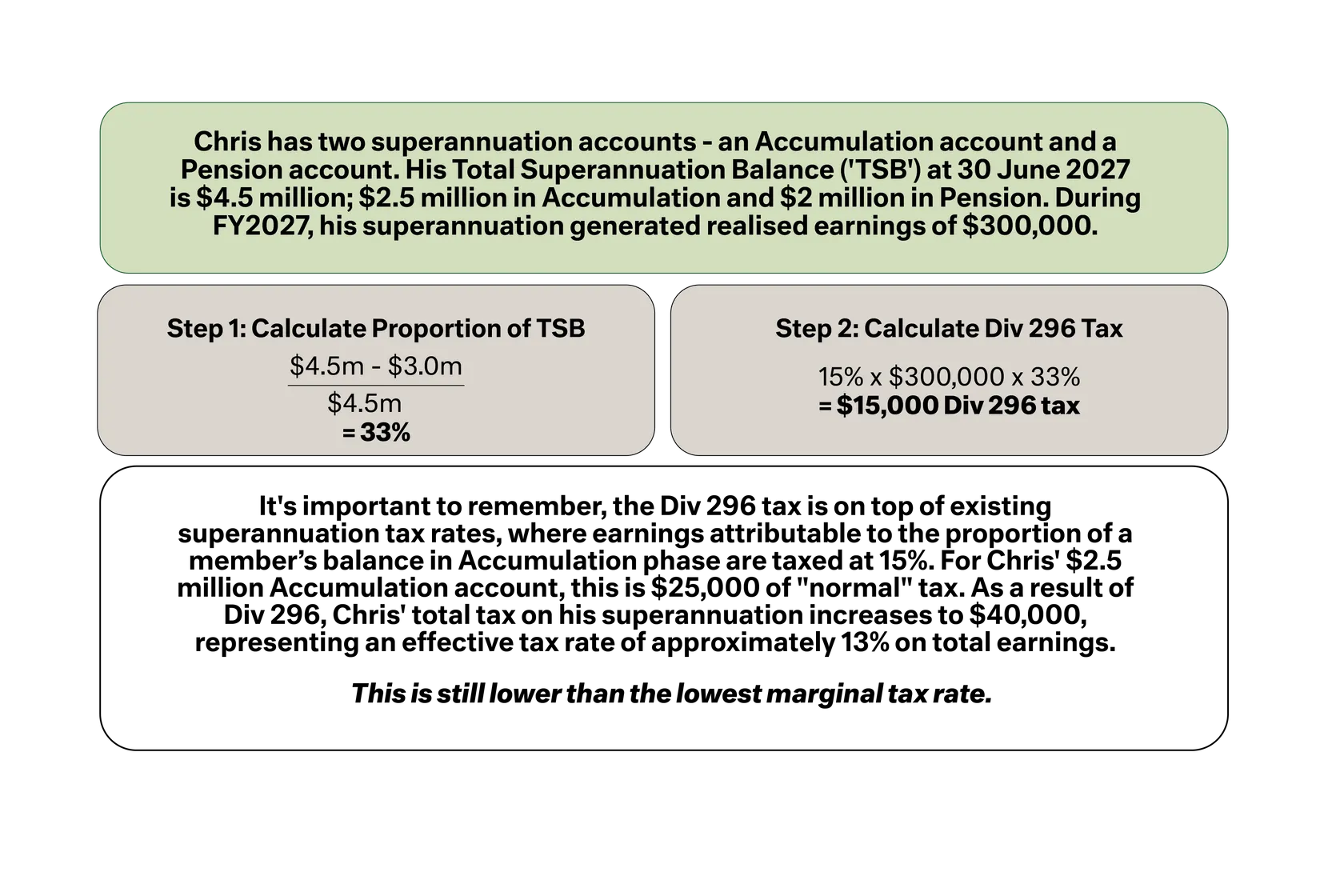
The ATO will perform the Division 296 calculation, which provides practical relief for members and their accountants. The process identifies the portion of a member’s balance above each threshold, determines the proportion of realised earnings attributable to that portion, and applies the relevant additional rate. 

For balances between $3 million and $10 million, the additional rate is 15%, bringing the effective rate in accumulation phase to 30%. For balances above $10 million, the additional rate is 25%, bringing the effective rate to 40%. When earnings are lower in a given year, or negative, that outcome flows through to the calculation proportionately. In practice, this often shows up as years of modest or nil additional liability for members whose realised earnings are managed carefully, punctuated by larger liabilities in years when significant disposals occur. 

The standard one-third capital gains tax discount continues to apply to eligible gains before the Division 296 calculation is performed.  

Worked Example: 

Diagram - Division 296 calculation

Unlike the existing 15% accumulation phase tax, Division 296 is levied on the individual member rather than the superannuation fund. Members who are assessed will receive a personal notice and may choose to pay the liability personally or request a release of funds from their superannuation.

This is arguably the most consequential question, and the one most prone to reactive decision-making. When Division 296 was first proposed in 2023, some investors withdrew capital from superannuation to avoid what was then a tax on unrealised gains - a feature that has since been removed. Those decisions, made on incomplete information, often resulted in worse outcomes than remaining within the superannuation environment. 

Over more than fifty years of advising business owners and families on private wealth, we have observed consistently that clients who focus on optimising tax across their whole of wealth achieve more sustainable and balanced outcomes than those who focus narrowly on minimising a single tax. 

Superannuation remains one of the most tax-effective investment environments available in Australia. Moving capital outside of superannuation may reduce Division 296 exposure but frequently results in higher marginal tax rates on investment income, loss of the pension phase tax exemption on drawdowns, reduced asset protection, and diminished estate planning flexibility. When these factors compound over a long holding period, the net position outside superannuation is often materially worse than the Division 296 liability itself. In practice, this often shows up as a client’s modelled after-tax position outside of super being lower over 10-15 years, even after accounting for the additional Division 296 tax. 

Division 296 applies from 1 July 2026, with the first year structured so that only the balance at 30 June 2027 determines whether the thresholds are met. This provides a clear planning window, and there is no need for hasty decisions.

Some commentary has described Division 296 as introducing a form of “death tax” on the basis that tax liabilities on superannuation interests may continue to accrue between a member’s death and the point at which benefits are paid to beneficiaries. While this is a legitimate planning consideration, it is one of several factors, alongside binding death benefit nominations, reversionary pension elections, and broader estate structuring, that require coordinated attention. 

When death benefit strategies are deferred or treated in isolation, the interaction between Division 296 liabilities and existing superannuation death benefit taxation can produce suboptimal outcomes that compound over the settlement period. In practice, this often shows up as estates incurring additional tax because benefit payment nominations were not reviewed in light of the new regime. 

With appropriate structuring and proactive planning, these outcomes can be managed effectively. The key is ensuring that death benefit strategies are aligned with broader estate objectives well before they are needed.

As Division 296 commences on 1 July 2026, SMSF trustees have the opportunity to elect a cost base reset - effectively resetting the cost base of all fund assets to their market value at that date, for Division 296 purposes only. This means future gains or losses for the Division 296 calculation are measured from the commencement date rather than historical purchase cost. 

This election is significant for funds carrying substantial unrealised gains or losses that have accumulated over many years. When the cost base is not reset, those embedded gains will be captured in future Division 296 calculations as assets are sold, even though the gains accrued before the regime existed. In practice, this often shows up as legacy “set and forget” portfolios facing materially different Division 296 outcomes depending on whether the election is made. 

The election must be made by the due date for lodging the fund’s 2026–27 tax return, applies to all assets in the fund (there is no ability to select individual assets), and is irrevocable. It does not alter the existing cost base of assets for ordinary capital gains tax purposes - it is an adjustment that applies exclusively to the Division 296 calculation. 

For portfolios that are actively managed and where gains are taken progressively, the reset is less consequential. Where investment management is disciplined and profits are realised consistently over time, portfolios generally do not carry large, embedded gains, and tax outcomes are managed progressively rather than deferred. 

Because Division 296 is assessed at the individual member level, the structure of fund membership matters. A couple who are both members of the same SMSF can hold a combined balance of up to $6 million before either member individually exceeds the $3 million threshold. 

This creates planning considerations around contribution strategies, benefit splits, and asset allocation between members. When balances are unevenly distributed between spouses, one member may trigger Division 296 while the other remains well below the threshold, producing a different aggregate outcome than if the same total balance were split more evenly. In practice, this often shows up as an opportunity to review spousal contribution strategies or consider recontribution arrangements in the lead-up to 1 July 2026. 

For SMSFs specifically, the cost base reset election is made at the fund level, not the member level. This means the election affects all members of the fund, which requires consideration of each member’s individual circumstances before a decision is made.

The period between now and 1 July 2026 represents a planning window, not a deadline for action. The transitional rules for the first year mean that Division 296 liability for 2026–27 will be determined solely by the member’s balance at 30 June 2027 - providing additional time to assess and implement any structural changes. 

Practical steps to consider include obtaining current valuations for all fund assets (particularly unlisted investments and property), reviewing unrealised gains and losses within the fund, assessing how assets are held across superannuation and non-superannuation structures, and considering the cost base reset election for SMSFs. 

When legislative change prompts hasty restructuring, the resulting decisions often create more complexity and cost than the tax they were designed to avoid. In practice, this often shows up as investors who acted precipitously in 2024–25 now reconsidering their position following the removal of the unrealised gains provision. 

A measured approach, one that integrates Division 296 into a broader wealth strategy encompassing investment, estate planning, and structural considerations, will invariably produce better long-term outcomes.

Division 296 does not operate in isolation. Its interaction with existing superannuation taxation, capital gains tax concessions, pension phase exemptions, and death benefit rules creates a layered environment where decisions in one area compound across others. A withdrawal from superannuation that reduces Division 296 exposure may simultaneously increase personal marginal tax rates, trigger capital gains liabilities, and forfeit estate planning protections - outcomes that are difficult to reverse once crystallised. These compounding effects are most acute at transition points: succession events, liquidity events such as business sales, changes in governance or trustee structure, and periods of illness or incapacity. Understanding how Division 296 integrates with these broader dynamics is what separates a strategic response from a reactive one.

Superannuation has always operated within a framework of evolving regulation, and Division 296 represents the latest adjustment to that framework rather than a departure from it. For those affected, the question is not whether to remain within superannuation but how to calibrate their position across structures, time horizons, and family circumstances. Durable outcomes come from governance, discipline, and a willingness to plan across generations - not from reacting to any single legislative change. The families and business owners who approach this thoughtfully, with a focus on stewardship and long-term continuity, will be well positioned regardless of how the regime evolves. 

Click here to organise a time with one of our experts to discuss how Div 296 could affect you. 

Who does Division 296 apply to?

Division 296 applies to individuals with a total superannuation balance exceeding $3 million. The tax is assessed at the individual member level, not the fund level, meaning a couple in the same SMSF could hold up to $6 million before either member is affected. Balances across all funds - accumulation and pension - are combined when determining whether the threshold is met. 

Does Division 296 tax unrealised gains?

No. The final legislation, passed in March 2026, applies only to realised earnings - income such as dividends, interest, and rent, plus capital gains that have been crystallised through the sale of assets. The earlier proposal to tax unrealised gains was removed during the consultation process, which is a meaningful change from the version first announced in 2023. 

What are the Division 296 tax rates?

An additional 15% applies to earnings on the portion of a balance between $3 million and $10 million, bringing the effective rate to 30% in accumulation phase. An additional 25% applies to earnings on the portion above $10 million, bringing the effective rate to 40%. Both thresholds are indexed to CPI over time. 

What is the cost base reset?

SMSF trustees may elect to reset the cost base of fund assets to their market value as at 1 July 2026, for Division 296 purposes only. This means future gains or losses are measured from that date rather than historical purchase cost. The election applies to all assets in the fund and must be made by the due date for the fund’s 2026–27 tax return. It does not alter cost bases for ordinary capital gains tax purposes. 

When does Division 296 take effect?

Division 296 applies from 1 July 2026. The first year has a transitional rule: the calculation uses only the member’s total superannuation balance at 30 June 2027. First ATO assessments are expected to be issued after 1 July 2027 for the 2026–27 financial year. 

Speak to one of our advisers to learn more: james.cummings@cameronharrison.com.au

Sourced from:

Photo by Istock