
Fixed Income: RBA Rates – Oscillating Expectations
Investment Solutions
Fixed Income: RBA Rates – Oscillating Expectations
By

Tristan Bowman, Partner

2025 was the year of living dangerously for the RBA. Inflation was moderating but employment markets remained historically tight. The question was simple yet uncomfortable: could they begin cutting rates and trust that inflation would keep moving in the right direction?
Posted 26 February 2026

For a while, the answer looked like yes. The slow and steady approach seemed to be delivering. But recent data releases have shifted the picture. Several indicators now point to a re-acceleration in inflation at the same time employment markets are tightening again.

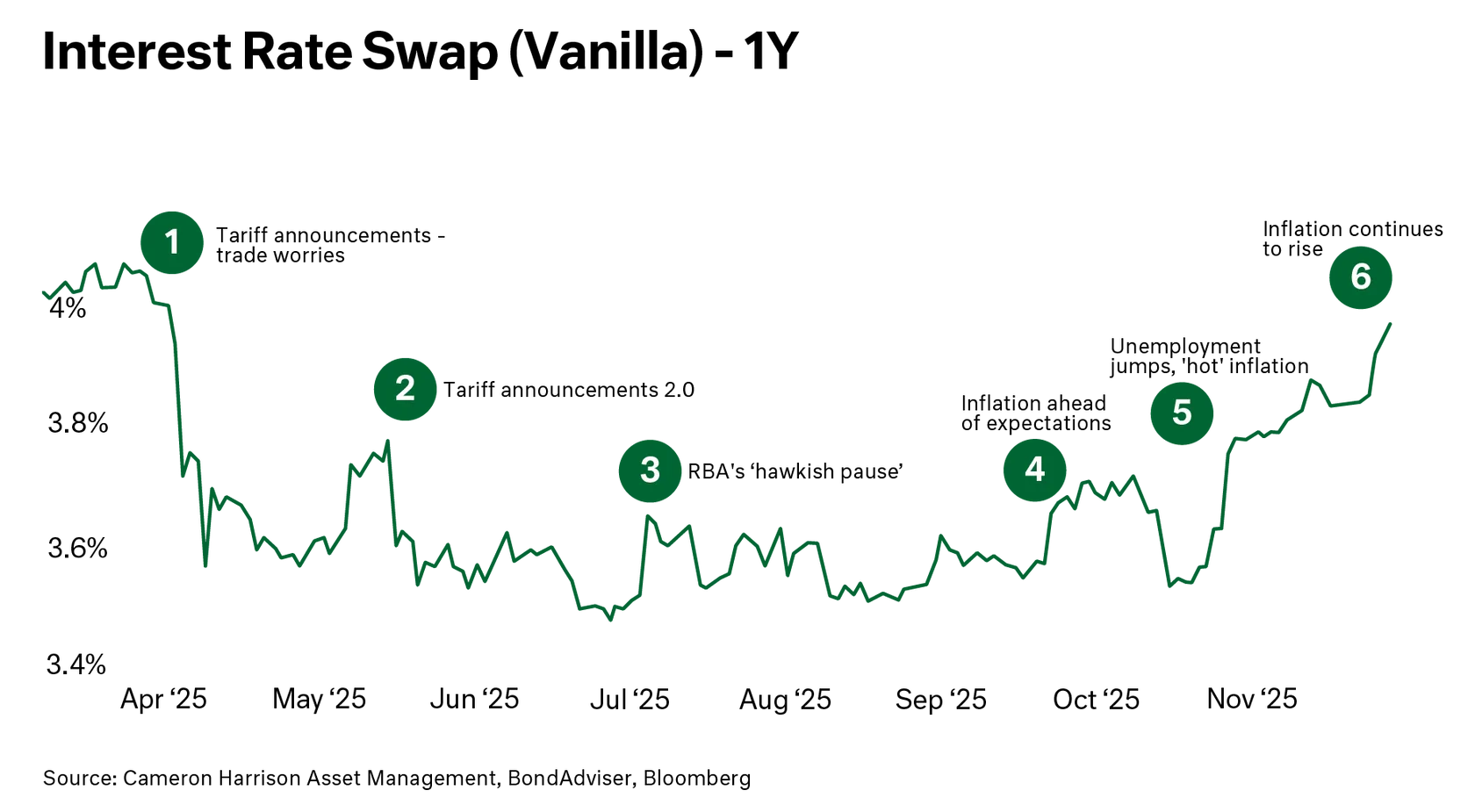
Through 2025, rate cut expectations oscillated; rate markets have reacted sharply to every data point. In April, markets priced in rate cuts to below 3% as Trump tweeted his way to tariff ‘victory’ and expectations of a global trade downturn emerged. In subsequent months, these fears abated, and local rate markets refocused on local data points.

By the end the year, the narrative had shifted away from rate cuts to the possibility of rate hikes in 2026. A flurry of inflation, labour market and housing data emerged in October and November, all pointing to an environment in which the supply side of the economy remains constrained. The consensus now is that the RBA’s next move will be up, not down.
Fixed Income: RBA Rates – Oscillating Expectations

The RBA’s dual mandate (price stability and employment) can be problematic. Policy can be caught between the two aims.

From 2022, the RBA has tried to thread the eye of the needle by allowing inflation to slowly return back to target whilst preserving the jobs that have been created (mostly government-related).

It is clear now that the job of calming inflation is not done. Inflation is reaccelerating in service-lead areas such as construction, education and health.

But goods inflation remains muted (as it has been for 20 years, goods inflation is not the issue). This is a services supply side problem: Australia simply does not have enough resources (labour and capital) to meet demand.

Rate markets both short and long have been hypersensitive to labour and inflation data, highlighted in the chart above.

The oscillating market views are driving the volatility in rates. We expect this to continue as the RBA tries to navigate their dual goals of price stability and full employment. The Bureau of Statistics moving to monthly inflation data releases only exacerbates this.

Volatility in interest rate markets means two things: firstly, larger swings in capital prices for fixed rate bonds, and secondly, opportunity for unleveraged investors. In the same way equity market volatility can provide opportunities to buy well-run and financially sound businesses at discounted prices, we are likewise able to buy high quality fixed income securities at reasonable prices when we see interest rate volatility.

This applies both to fixed rate bonds which are more sensitive to interest rate movements, and floating rate securities when credit margins expand with base rate movements.

For our Core Interest Income strategy, we do not speculate on short-term positions but rather take long-term positions where we see opportunities. Our purpose is to build strategies that will deliver sustainable returns over the medium-term. We continue to opportunistically purchase longer-dated fixed rate bonds when government bond yields are elevated (>4.5%) but otherwise remain predominantly floating rate.

Watch Tristan's full analysis:

Speak to one of our advisers to learn more: tristan.bowman@cameronharrison.com.au

Sourced from:

Photo by iStock