Australia is facing structurally lower growth but structurally higher interest rates.
Higher base rates allow investors to generate income with lower reliance on equities.
Fixed income can now play a larger role in building resilient portfolios.

Australia is facing structurally lower growth but structurally higher interest rates.
Higher base rates allow investors to generate income with lower reliance on equities.
Fixed income can now play a larger role in building resilient portfolios.
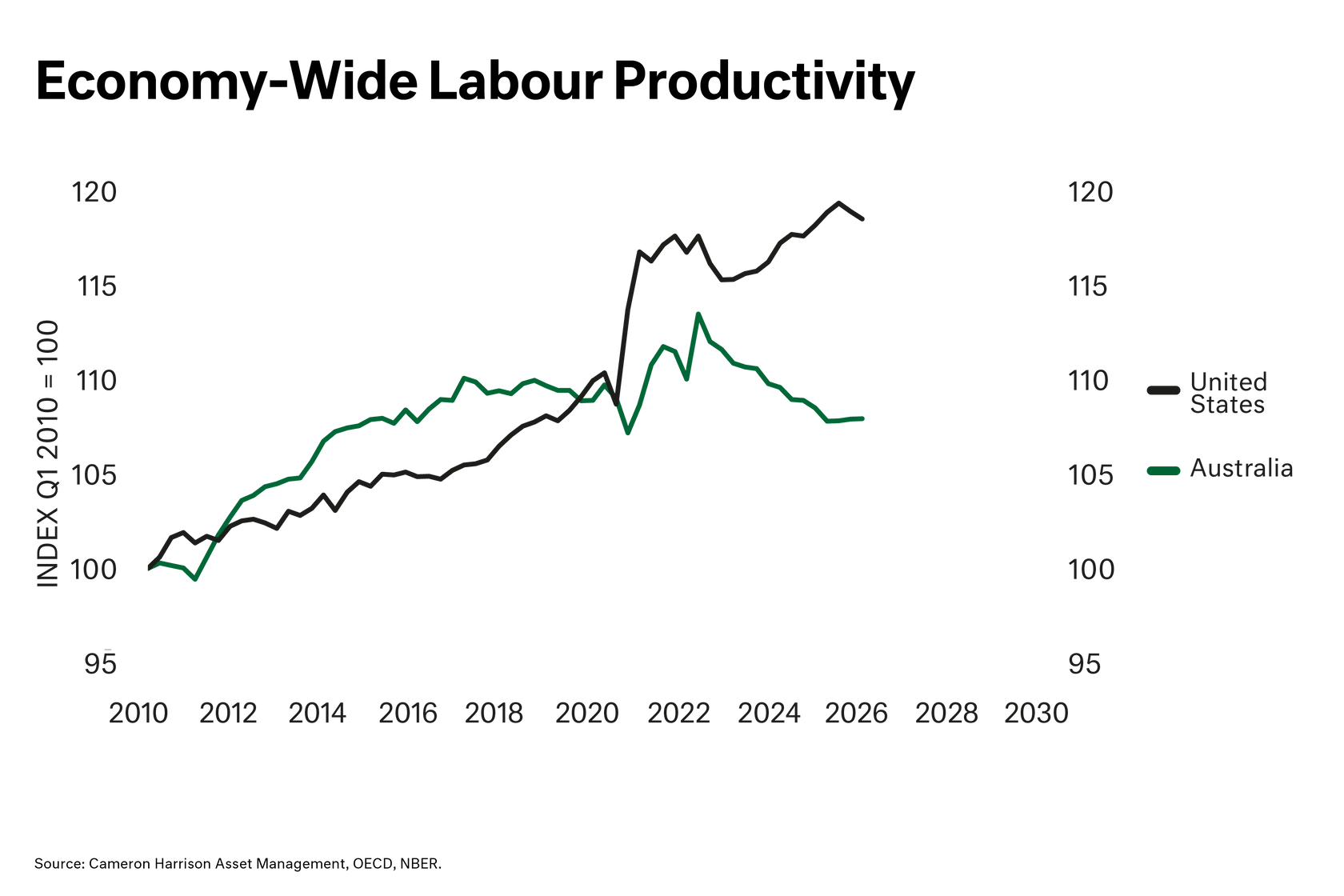
Low productivity and economic growth should translate to lower interest rates. Yet inflation remains above the RBA’s target range of 2%-3%, labour markets remain historically tight, and interest rates sit roughly three percentage points higher than they did in 2019.
These contrasting positions create both opportunities and obstacles.
Two structural shifts distinguish the post-Covid environment from the decade before it:
A materially larger government footprint – government spending now represents a significantly higher share of GDP, providing ongoing demand that keeps prices under pressure.
A surge in population growth through migration, adding to headline GDP growth but placing sustained demand on housing, services, and labour markets.
Neither factor is likely to moderate meaningfully in the near term. As a result, we are unlikely to return to the ultra-low 0.75% RBA cash rate seen pre-pandemic. Higher base rates are becoming the norm, not the exception.
For unleveraged investors who derive an income stream from their capital, higher rates is a good thing. In essence, it means you can generate higher levels of income per unit of risk, meaning investors are less reliant on capital growth to generate appropriate returns to fund lifestyle expenses.
Take an investor who is retired with $4 million of superannuation to fund their lifestyle expenses which was $200,000 in 2014 and has been indexed by 3% each year. They have a moderate risk tolerance and seek to protect against the downside. The chart below shows income (cash flow) compared to drawings over a 10-year period. In FY2022 the market risk exposure was over 60%, today it is just over 50%.
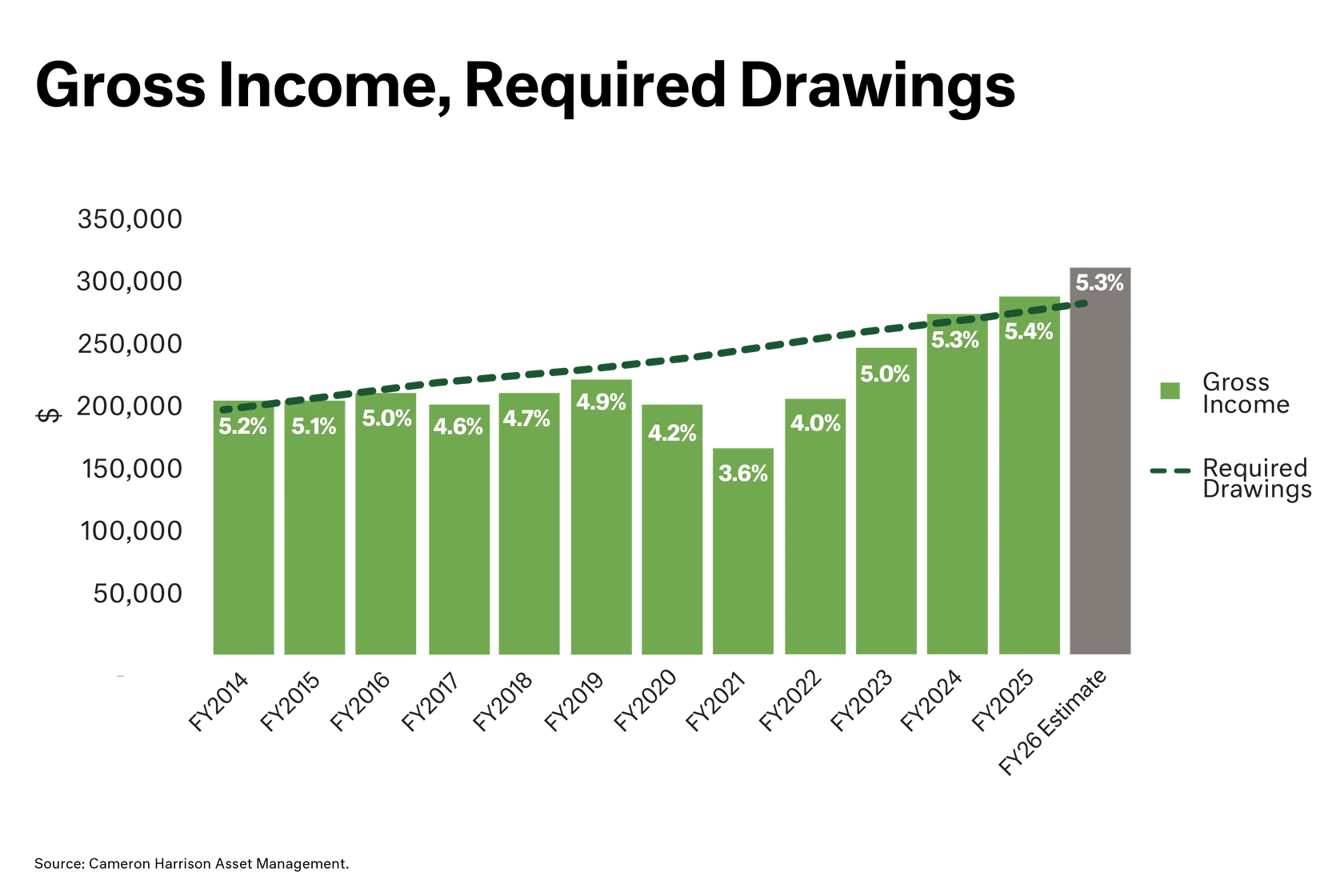
Today’s higher-rate environment allows them to meet their income requirements with a smaller allocation to equities, lowering overall portfolio risk and improving resilience across market cycles.
This shifts portfolio construction away from growth dependency toward income certainty, particularly relevant in periods of subdued economic expansion.
Our Core Interest Income Strategy is a diversified strategy of investment-grade debt securities, both secured and unsecured. It forms the largest part of our Balanced asset allocation strategy. We seek to generate income yields of 2% above the RBA Cash Rate, providing investors with appropriate levels of sustainable income with very low risk to capital.
The benefit to investors of a higher RBA Cash Rate is simple: greater levels of cash flow for lower levels of risk. Rather than being reliant on Australian equities for income, investors can generate yields of ~5.5% with very low capital variability
Market expectations of RBA rate cuts have been extremely sensitive to the most recent piece of economic data. Recent inflation and unemployment figures have cauterized any hope of another rate cut in 2025, and perhaps even 2026.
The chart below shows the RBA Cash Rate (historical and future expectations) with a 2% margin on top. Compared to pre-Covid rates, investors can generate close to 3% more in income with no increase in risk.
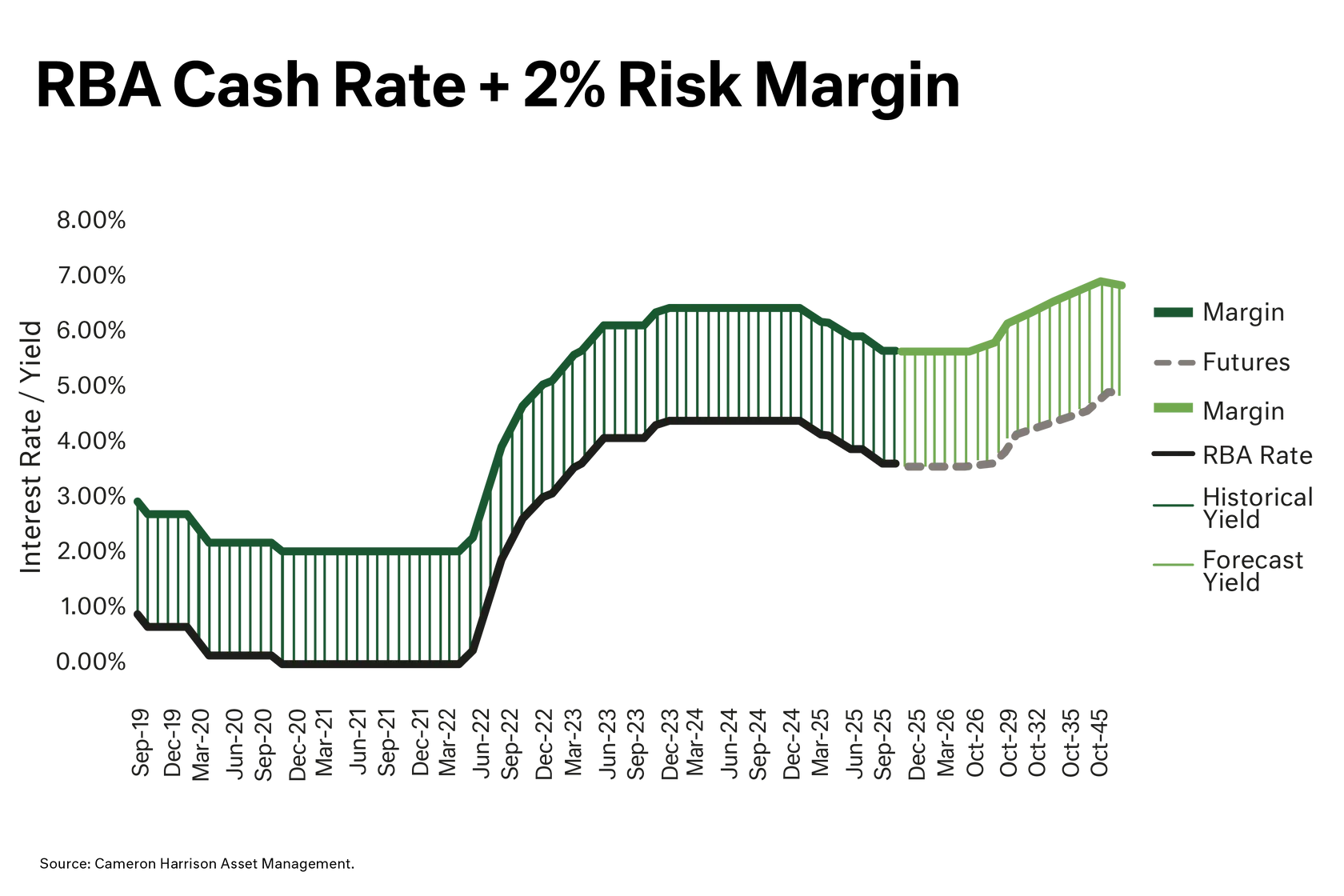
Futures markets (light green) demonstrate the expected rate path from here. With the RBA cash rate elevated, investors can now generate yields around 5.5% from high-quality fixed-income alone. This reduces the need to stretch into higher-risk assets or depend heavily on dividends to fund spending.
Over the medium term, the more relevant shift may not be the exact path of interest rates, but the realisation that structurally higher rates provide a different, and potentially more stable, foundation for long‑term portfolios.
Low economic growth would normally reduce inflation and allow central banks to cut interest rates. However, in the current environment, persistent inflation, a tight labour market, and structural demand from government spending and migration have kept inflation elevated. As a result, the RBA has had limited capacity to reduce rates despite weak productivity and subdued GDP growth.
Higher interest rates increase the income available from lower‑risk assets such as cash and high‑quality fixed income. This means investors can generate stronger and more predictable cash flow without needing to rely as heavily on equities or capital growth. In practice, this can improve portfolio stability and reduce exposure to market volatility.
Higher base rates can shift asset allocation towards income‑producing assets rather than growth‑dependent strategies. Fixed income can now play a larger role in delivering returns, allowing investors to meet income requirements with lower equity exposure. This may result in more resilient portfolios, particularly in periods of subdued economic growth.
Sourced from: