
Downweighting Down Under: Australian Equities

Investment Solutions
By David Clark, Deputy Chief Investment Officer
Posted 24 September 2026
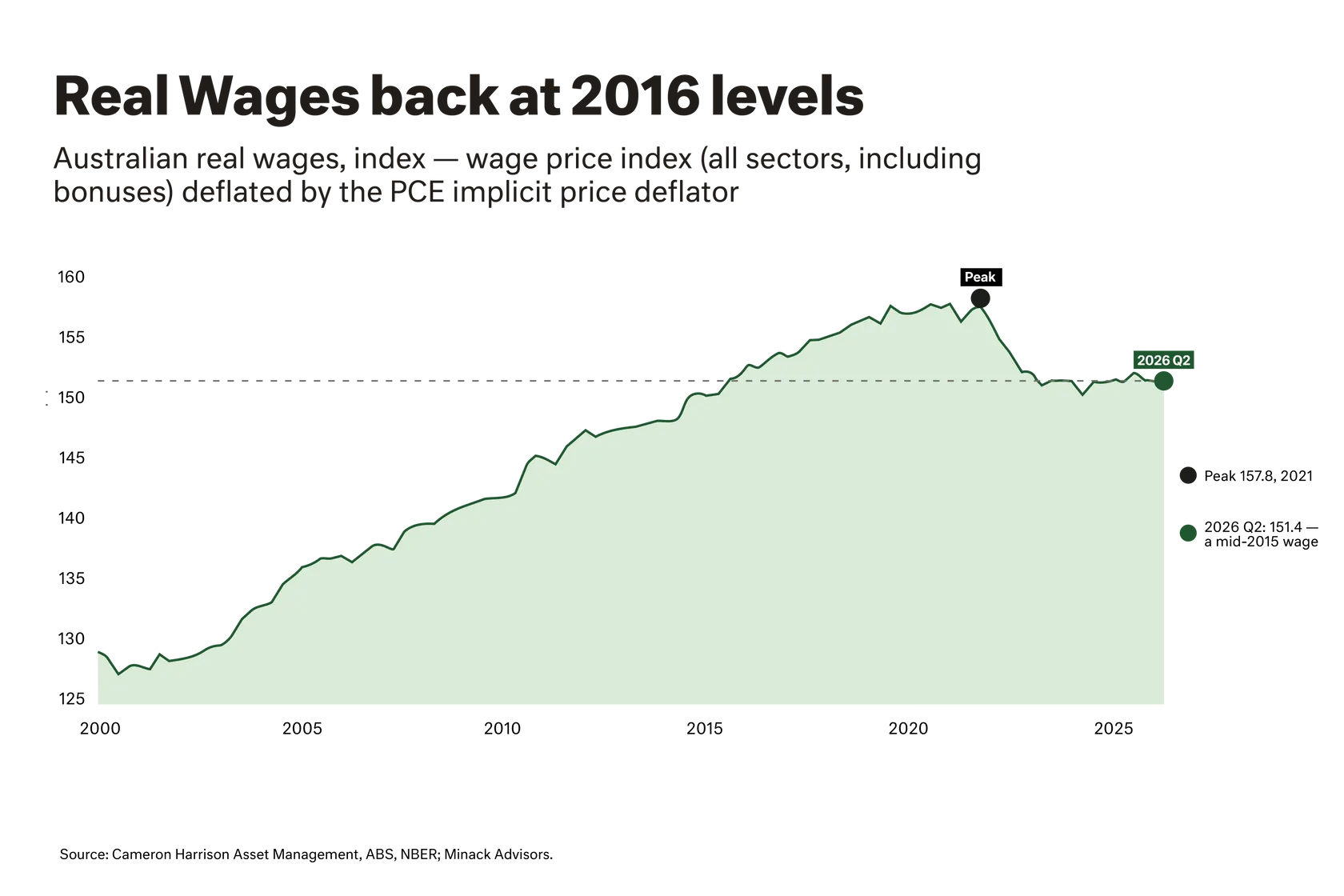
  • Australia's problem is productivity, not the cycle: Investment spending is barely keeping pace with population growth, so there is no capital deepening and no productivity growth. Real wages have fallen back to where they sat in 2015.

  • The Reserve Bank has to keep leaning on a flat economy: Wage growth of just over 3% without any productivity offset feeds service sector inflation that does not fit a 2% to 3% target. Policy stays restrictive even though income per person is going nowhere.

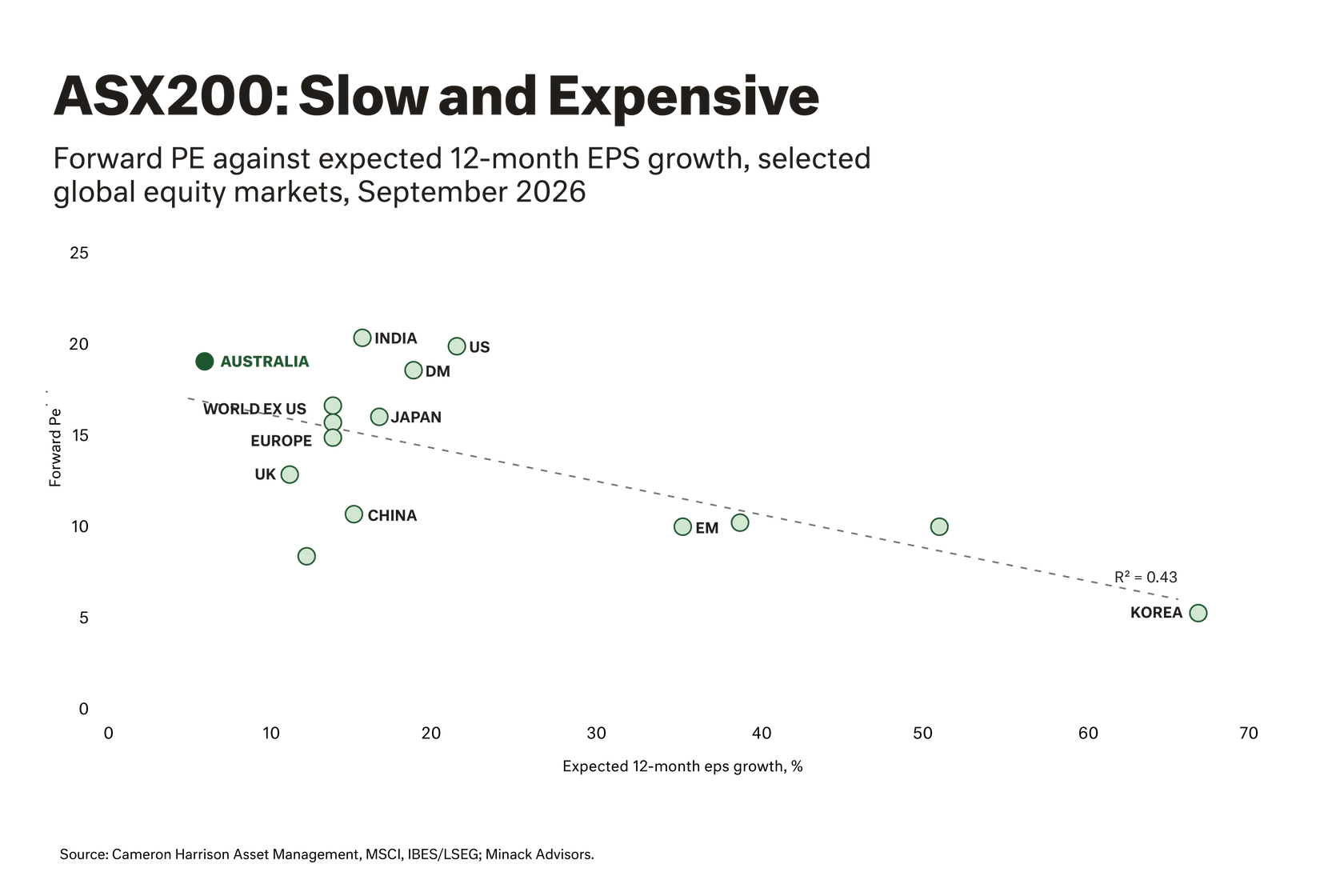
  • Domestic stocks at a premium price for the slowest growth: Australian earnings forecasts are falling while the rest of the world enjoys an earnings boom, yet our market trades on a higher multiple than most of its peers. That combination is why we are underweight Australian equities.
Australia has not had a recession in a very long time. Households could be forgiven for not noticing.

Real household disposable income per person and real consumer spending per person have barely moved since 2012, and both sit well below the path they followed through the 2000s. The June quarter national accounts confirmed that nothing changed in the first half of 2026. Per capita GDP flatlined.

Labour income is the largest part of household income, and that is where the problem shows up most plainly. Real wages, meaning what a pay packet actually buys, have fallen back to their 2016 level. That is 11 years of effort for no gain in purchasing power.

This is not a bad patch. It is the pattern. And it has a direct bearing on how much of your portfolio we think belongs in Australian shares.

Graph - Real wages back to 2016 levels

The chain runs like this. Real wages can only rise sustainably if productivity rises, meaning each hour of work produces more. Productivity rises when workers are given more and better equipment to work with, which economists call capital deepening. Capital deepening requires business investment to grow faster than the workforce.

Australian investment spending is barely keeping pace with population growth. The capital each worker has to work with has gone sideways, so labour productivity has gone sideways, so real wages have gone sideways. Every link in that chain has been stuck for a decade.

This is the root cause, and almost everything else in the Australian economic story follows from it.

Productivity growth sets the speed limit for the whole economy. If wages rise by 3% and output per hour does not rise at all, then the cost of producing each unit rises by 3%. In a service economy, where labour is the main input, that lands in prices.

Which is exactly what has happened. Inflation eased to 3.5% over the year to July, but trimmed mean inflation, the measure the Reserve Bank watches most closely, held at 3.6%. Both sit above the 2% to 3% target band. The cash rate is 4.35% after three increases during 2026, and markets are pricing a further rise at the 29 September meeting. All four major banks now expect at least one more increase before the end of the year.

So, the Reserve Bank keeps tightening into an economy that is not growing on a per person basis. That sounds perverse, and for households it feels it. It is also the logical consequence of a country whose costs keep rising while its output per hour does not.

Earnings growth for global markets over the year ahead sits at a level normally seen only when economies are rebounding out of recession. Australian earnings forecasts, by contrast, are being revised down.

By plotting expected earnings growth for the major global markets against what investors are paying for those earnings, we see that Australia sits in the least attractive corner of the chart: among the most expensive markets, and among the slowest growing. The ASX 200 has been trading around 9,000 points on roughly 20 times earnings. That multiple would be easier to accept in a falling interest rate environment. Paired with a central bank still raising rates, it is harder to justify.

Graph - ASX200 Slow & expensive

We are underweight Australian equities and have been for some time. The money that would otherwise sit here is invested in global equities, where the same dollar buys faster earnings growth at a lower multiple.

Australia remains a very good place to live but it is currently an expensive place to own the average listed company.

Does being underweight mean we own no Australian shares?

No. Underweight means holding less than the benchmark weight, not nothing. We continue to own Australian companies where the business quality and the price justify it.

Do franking credits change the picture?

They improve it, and Australian investors are right to value them. But a franking credit is a refund of tax already paid on profits. It does not create profit growth. If earnings grow slowly, the credit softens the outcome rather than fixing it.

What would make us change our minds?

A sustained lift in business investment per worker, followed by evidence of real productivity growth, would change the foundation of the argument. So would a fall in Australian valuations to a level that properly compensates for the slower growth. We watch both.

Speak to one of our advisers to learn more: david.clark@cameronharrison.com.au